14
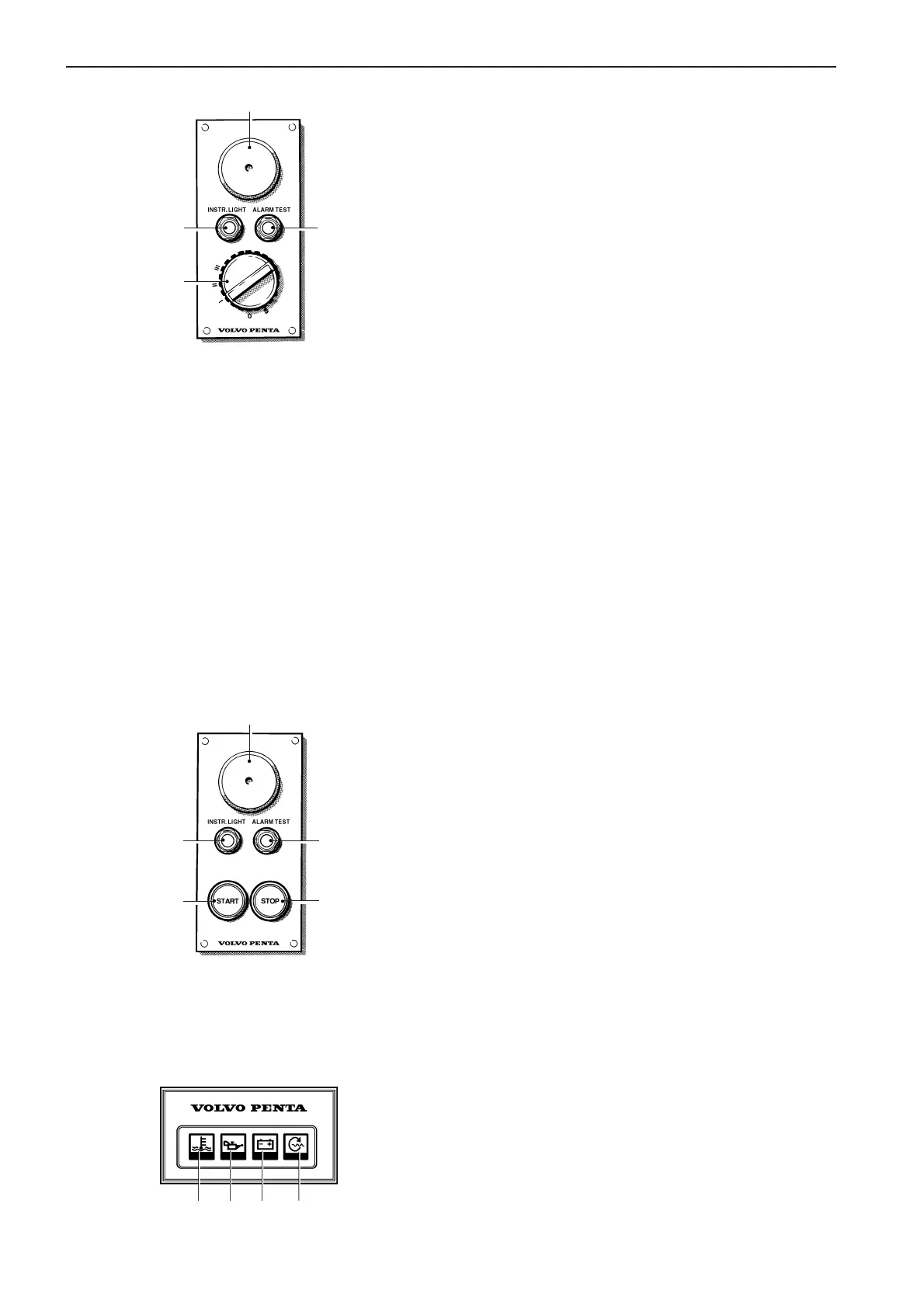
Control panel for pilot house (main
panel)
32. Key switch (start lock) with start and stop func-
tions and a built-in restart inhibitor (starter motor
protection).
The restart inhibitor means that new attempts to
start can be made only once the key has been
returned to the stop position (S).
33. Pressure switch for instrument lighting.
34. Alarm (siren) for malfunctions. Sounds when lu-
bricating oil pressure is too low (engine), when
coolant temperature is too high or there is a loss
of charge.
35. Pressure switch for testing alarm functions or ac-
knowledging alarms.
– No alarm: Alarm test (all warning lamps come
on and the siren sounds).
– If the alarm sounds: Alarm acknowledge-
ment.*
*The siren stops but the warning lamps continue flashing until
the malfunction has been corrected. If a new alarm condition
occurs, the siren sounds again and the next warning lamp
starts to flash, and so on.
Control panel for alt. operating position
Position numbers refer partly to the equivalent func-
tions in the pilot house panel above.
Note: The key switch in the pilot house control panel
must be in position I (operating position) for starting
to be carried out from the secondary operating posi-
tion.
Engines with starter element: The starter element
may be engaged only via the key switch on the panel
in the pilot house.
36. Starter button. The starter motor is engaged
when this button is pressed. Release the button
as soon as the engine has started.
37. Stop button. The stop solenoid or stop valve is
engaged when this button is pressed.
Alarm panel
The alarm panel has warning symbols corresponding
to those in the main panel (pos. 11–14).
11 12 13 14
34
3533
32
34
35
37
33
36



 To Next Page