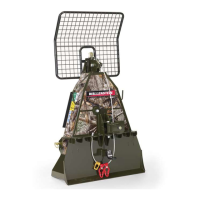
Operating Instructions
FX85, FX110, FX140
Skidding Winch
30
6.5 Synthetic Winch Rope Safety
WARNING!
A steel cable or synthetic winch rope that fails
under tension can snap back with great force
causing injury or death. Avoid sudden jerks, and
quick starts or stops. Start slowly and smoothly.
Replace a cable or winch rope that is kinked,
badly frayed, has knots, cuts, or broken strands.
IMPORTANT! Heat and exposure to ultra-violet (UV) light
break down the fibers of synthetic rope, which weakens the
rope and makes it brittle over time. Frequent use in mud,
dirt, and sandy conditions can also damage a synthetic rope
if it is not thoroughly cleaned and cared for.
Models that come with a synthetic rope from the factory are
FX85S, FX85RS, FX110S, FX110RS, FX140S, FX140RS.
The synthetic winch rope that is included with the machine is
a plastic-based rope. Due to its construction, it is lighter than
steel cable; however, it is necessary to do more to maintain
a synthentic winch rope. It is susceptible to abrasion and
becomes brittle over time. Use caution when winching or
skidding logs with a synthetic winch rope or synthetic choker.
When using a synthetic winch rope, avoid the following:
• Walking on the winch rope.
• Winching or skidding through abrasive or sharp surfaces
(for example: rocks, concrete, mud, sand).
• Winching with low rope tension.
• Excessive exposure to heat and UV radiation.
• Exposure to harsh chemicals.
Regular cleaning and inspection of the winch rope's condition
is necessary. For more information, see Synthetic Winch Rope
Maintenance on page 49.
6.6 Apply Tension to a New Cable or
Winch Rope
IMPORTANT! Leave a minimum of 3 ft (1 m) of cable or
winch rope on the winch drum. If you pull the cable or winch
rope out fully, the end can pull off the anchor.
Before it is used for the first time, a cable or winch rope must
have tension applied to prevent additional stretch during
operation.
1. Attach the machine to a tractor.
For instructions, see Attach to a Tractor on page 34.
2. Find a large, solid tree that is safe to use as a winch anchor
and a clear path from it that is the same length as the cable
or winch rope.
3. Park the tractor three feet closer to the tree then the length
of the cable or winch rope.
4. Disengage the tractor PTO and apply the parking brake.
5. Stop the tractor engine and remove the ignition key.
6. Pull the cable or winch rope to the selected tree.
Leave a minimum of 3 ft (1 m) of cable or winch rope on
the winch drum.
7. Attach the cable or winch rope to the tree.
For a cable that does not have a forged end or a synthetic
winch rope, use a choker chain or synthetic choker.
8. Start the tractor engine and engage the PTO.
9. Set the tractor PTO speed to approximately 200 rpm (the
winch speed is based on the tractor PTO speed).
10. Optional: If you want to increase the tension that is applied
to the cable or winch rope, lower the tractor front-end
loader bucket to the ground.
Do not apply more weight than the cable or winch rope can
hold.
11. Lift the three-point hitch to keep the skidding winch off the
ground.
12. Disengage the tractor parking brake.
13. Do one of the following to wind the cable or winch rope and
winch the tractor:
• Pull firmly and hold the clutch-control rope.
• On the hand-held transmitter, push and hold the up
arrow button.
14. When the tractor is near the tree, do one of the following:
• Release the clutch-control rope.
• Release the hand-held transmitter up arrow.
15. Do steps 4 and 5 again.
16. Disconnect the cable or winch rope from the tree.


 To Next Page