Section 4
Auto-Zone CV & CV-EX
4-20 Start-Up and Troubleshooting
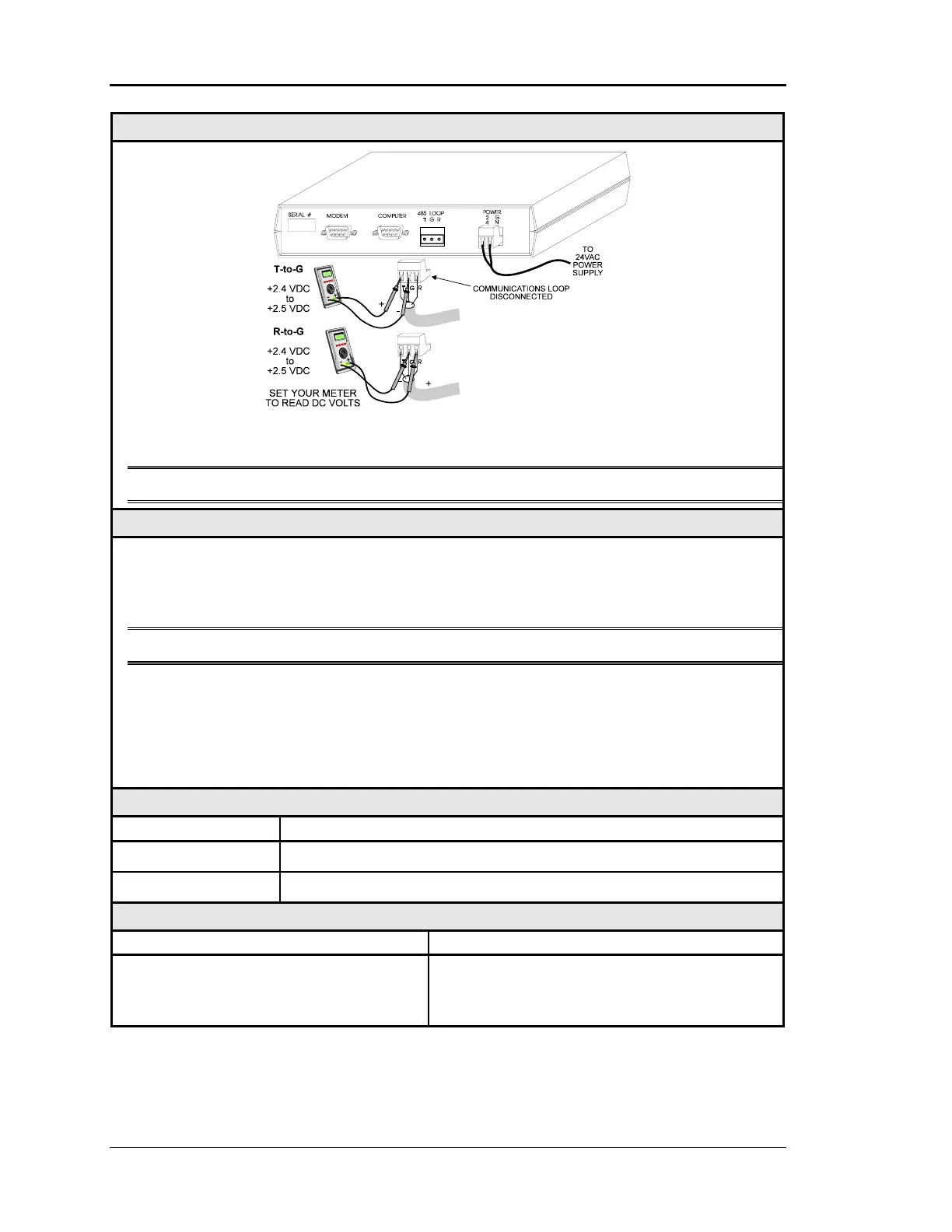
Diagram
The indicated values are typical of a normal system, actual readings may deviate slightly
due to the number of units connected and other system specific factors.
Note: All of the connected CV Controllers should be powered up for this test.
Overvie
This is a “quick check” to determine if any of the driver chips on the attached CV Control-
lers are damaged. Since all units will “float” both of their communications connections at
about 2.45 Volts, you can quickly check the entire communications loop by unplugging it at
the CommLink II.
Note: Be sure that the loop you are testing does not have a short circuit from T to R.
Tip: The Loop LED (located on the front panel) should “flicker” when the CommLink II is
attempting to communicate with the CV Controllers. There is a noticeable change in
the flicker when the loop is disconnected, if you observe a normal functioning unit.
When the loop is reconnected it may take up to 60 seconds before the CommLink II
re-establishes communications with the CV Controllers.
Measurements
Network Loop Acceptable Range
T - G (SHLD) 2.4-to-2.5 Volts DC
R - G (SHLD) 2.4-to-2.5 Volts DC
Action
Condition Action
If voltages are too high or too low on
either side
One or more of the CV Controllers has a dam-
aged Comm driver chip. Disconnect CV Con-
trollers one at a time to isolate the problem.



 To Next Page