37
I N S TA L L E R S e c t i o n ( e n )
7113156.01 (1-05/13)
CODE
DISPLAYED
FAULT POSSIBLE REASON SERVICE ACTION
E43 Shutdown due to probable
obstruction of air-ue duct
or insufcient gas inlet
pressure.
• See the causes indicated in E40
- E41
• Input voltage V<180V
(automatically resets at V>185V
or by pressing “R”).
• Electronic board faulty.
• See the actions indicated in E40 - E41.
• Check whether the power supply reductions are due
to reasons other than the boiler. If so, contact the
electricity provider
E50 Shutdown due to fumes
NTC probe tripping for
overheating.
• Fumes temperature>180°C.
• Insufcient heat exchange on the
water/fumes exchanger.
• Fumes NTC probe faulty.
• Electronic board faulty.
• Check the heat exchange of the water/ fumes
exchanger: insufcient circulation or presence of
scale.
• Check the fumes NTC probe (**).
E55 Gas valve not
electronically calibrated
• The electronic board has not
been replaced and the gas valve
has not yet been electronically
calibrated.
• Electronically calibrate the gas valve (parameters F45
and F48) as described in the GAS VALVE section
E62 Safety shutdown if the
ame signal or fumes
temperature fail to
stabilise
• Flame sensing electrode faulty or
incorrectly positioned.
• Fumes NTC probe faulty.
• Electronic board faulty.
• Check the wire is uninterrupted and makes good
contact with the ame sensing electrode and the
ignition switch.
• Check the ame sensing electrode is in good
condition and correctly positioned (see the
POSITIONING THE IGNITION AND FLAME-
SENSING ELECTRODE section).
• Check the fumes NTC probe (**).
E65 Safety shutdown if the air-
ue duct obstruction test
fails frequently.
• See the causes indicated in E40
- E41.
• See the actions indicated in E40 - E41.
E98 Electronic board
parameters incorrectly
congured
• The electronic board has been
replaced and not yet calibrated
for the boiler model.
• Parameters F03 and F12 have
not been set or have been
incorrectly set.
• Set parameters F03 and F12 with the values indicated
in the table in the SETTING PARAMETERS section
according to the boiler model indicated on the rating
plate.
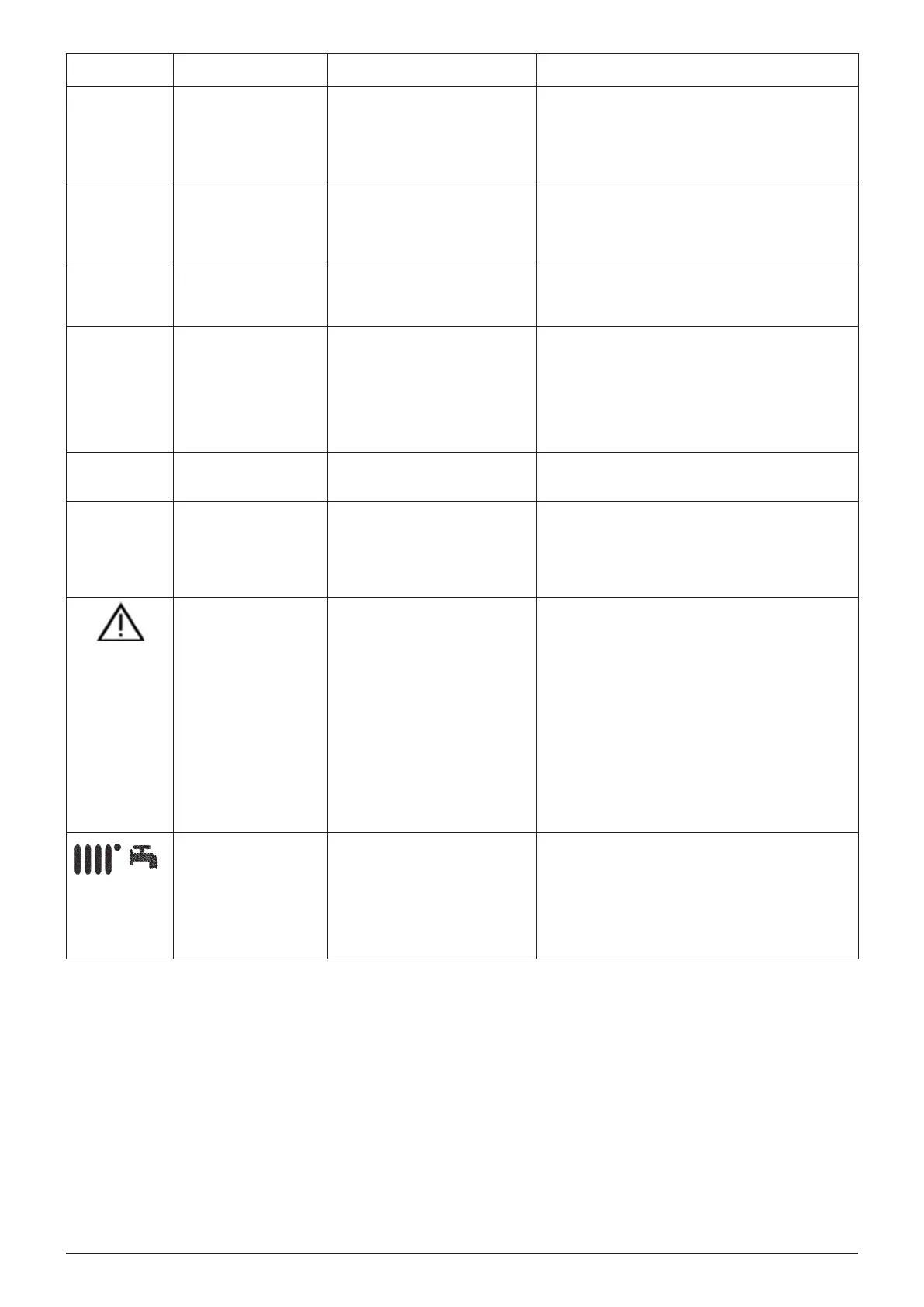
Flashing
Boiler operating at
reduced power.
• No inlet gas pressure.
• Gas valve modulator wires not
connected.
• Flame sensing electrode faulty or
incorrectly positioned.
• Air-ue duct partially obstructed.
• Gas valve faulty.
• Electronic board faulty.
• Check the gas supply pressure
• (for natural gas Palim.>9mbar).
• Check the connection of the gas valve modulator
wiring to the electronic board.
• Check that the pressure at the burner has been
correctly calibrated (see the GAS VALVE section)
• Check the ame sensing electrode is in good
condition and correctly positioned (see the
POSITIONING THE IGNITION AND FLAME-
SENSING ELECTRODE section).
• Make sure the air and ue ducts are not obstructed
and have been correctly installed (they must not
exceed the prescribed maximum lengths and must
be tted with the correct diaphragm – see the
INSTALLING THE DUCTS section).
Flashing
alternately
Scale alarm or incorrect
position of DHW NTC
probe.
• Scale in the DHW water/ fumes
exchanger circuit.
• The clip securing the DHW NTC
probe has detached from the
DHW outlet pipe.
• DHW NTC probe faulty.
• Secure the clip of the DHW NTC probe to the pipe
and check the contact with the heat-sensitive surface.
• Check the DHW NTC probe (*).
• Check for the scale in the water/fumes exchanger
(during DHW takeoff, the temperature of the DHW
outlet does not increase, while that of the CH ow
rises rapidly. Moreover, water ow is low as the
exchanger is partly obstructed).
CH = central heating
DHW = domestic hot water
(*) DHW NTC and CH delivery probe: cold resistance value: approximately 10 kΩ @ 25° C (resistance decreases as temperature rises).
(**) NTC fumes probe: cold resistance value: approximately 49 kΩ @ 25° C (resistance decreases as temperature rises).


 To Next Page
 Loading...