Instruction for use Examination and treatment table Easy Care
** Depending on model and configuration
D2151_01 - 09/2017 9/38
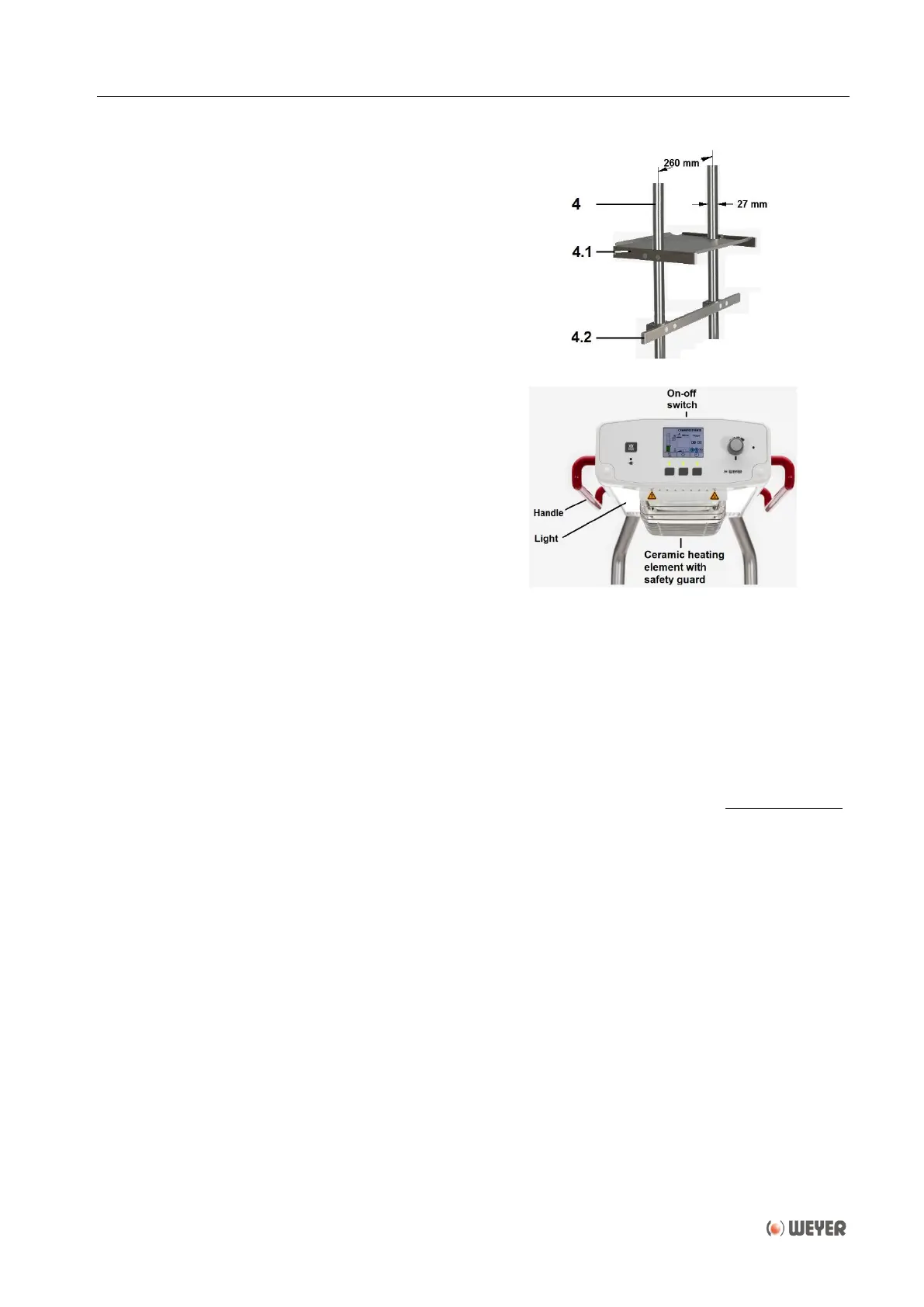
Two high-grade steel tubes are provided for
adaptation of the radiant warmer and for fixing
accessories and additional devices with fixture for
tube Ø 27 mm, e.g.:
Shelf WY3061** (optional)
Instrument rail 25 x10 mm WY3064** (optional)
For further upgrade items refer to chapter 9.1
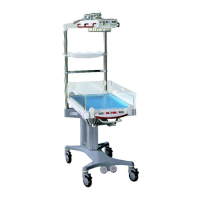
The radiant warmer is used for pre-warming the
patient deck and for maintaining the patient's body
temperature during the treatment. It generates
long-wave infra-red radiation energy in the far non
visible infra-red range.
The patient's upper skin layers are warmed-up and
small blood vessels expand. So the metabolism is
activated and the transport of heat in the blood is
accelerated.
The long-life ceramic heating element does not scale and is not affected by slight liquid splashes.
The radiation intensity emitted to the patient deck is selected defined in mW/cm². As an option the
selection can be changed into "heating capacity in percent". The selection and the radiation intensity
respectively the heating capacity (%) actually emitted to the patient deck are permanently displayed.
Deviations from the selected radiation intensity respectively heating capacity (% ) as well as system
faults and power failure are alerted visually and audibly
At intensity selection above 10 mW/cm², after 15 minutes the radiant warmer automatically reduces
the intensity to a safe value and alerts visually and audibly. The user can now reduce the intensity/
capacity selection or confirm the high intensity/capacity selection by keypress for the next 15 minutes.
For certain applications this safety function can be switched-off temporarily by a conscious action.
Refer to chapter 6.4 "Functions of the infra-red radiant warmer" as well as chapter 6.6.3 "Automatic
intensity reduction".
For even and dazzle-free illumination of the patient deck two panel lights are integrated in the radiant
warmer, their brightness can be adjusted in 5 steps. The colour temperature of 4000 Kelvin is optimal
for visual examination of the patient.


 To Next Page