11
WILDEN PUMP & ENGINEERING, LLCWIL-10230-E-02
SUGGESTED INSTALLATION
SECTION 7B – AIR OPERATION
SUGGESTED OPERATION AND
MAINTENANCE INSTRUCTIONS
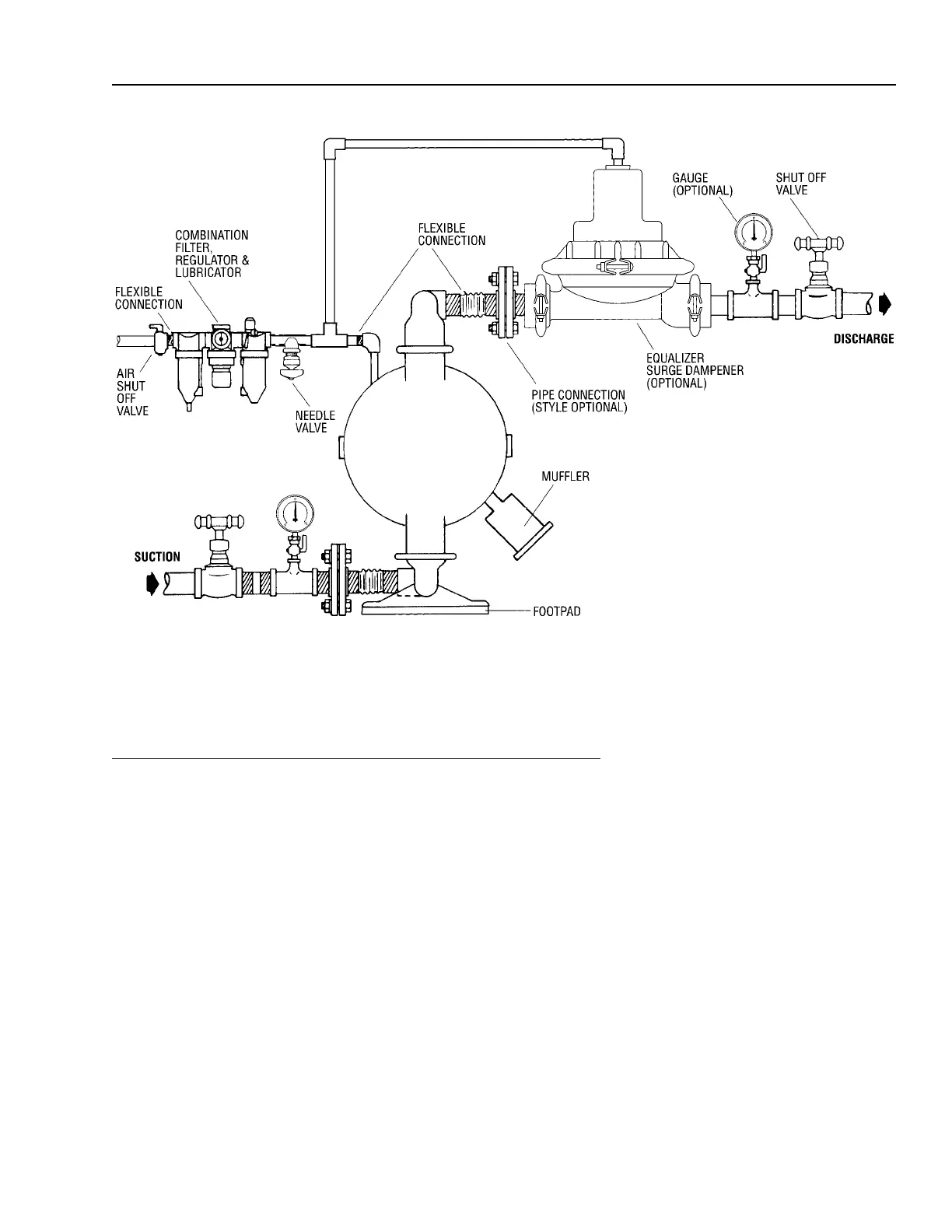
OPERATION: Pump discharge rate can be controlled by
limiting the volume and/or pressure of the air supply to the
pump (preferred method). An air regulator is used to regu-
late air pressure. A needle valve is used to regulate volume.
Pump discharge rate can also be controlled by throttling the
pump discharge by partially closing a valve in the discharge
line of the pump. This action increases friction loss which
reduces flow rate. This is useful when the need exists to
control the pump from a remote location. When the pump
discharge pressure equals or exceeds the air supply pres-
sure, the pump will stop; no bypass or pressure relief valve
is needed, and pump damage will not occur. The pump
has reached a “deadhead” situation and can be restarted
by reducing the fluid discharge pressure or increasing the
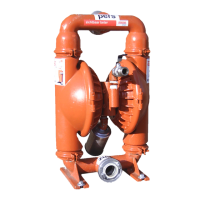
air inlet pressure. The Wilden T8 pump runs solely on
compressed air and does not generate heat, therefore your
process fluid temperature will not be affected.
RECORDS: When service is required, a record should be
made of all necessary repairs and replacements. Over a
period of time, such records can become a valuable tool
for predicting and preventing future maintenance problems
and unscheduled downtime. In addition, accurate records
make it possible to identify pumps that are poorly suited to
their applications.
MAINTENANCE AND INSPECTIONS: Since each applica-
tion is unique, maintenance schedules may be different
for every pump. Frequency of use, line pressure, viscosity
and abrasiveness of process fluid all affect the parts life
of a Wilden pump. Periodic inspections have been found
to offer the best means for preventing unscheduled pump
downtime. Personnel familiar with the pump’s construction
and service should be informed of any abnormalities that
are detected during operation.
AIR OPERATED PUMPS: To stop the pump from oper-
ating in an emergency situation, simply close the shut-
off valve (user supplied) installed in the air supply line.
A properly functioning valve will stop the air supply to
the pump, therefore stopping output. This shut-off valve
should be located far enough away from the pumping
equipment such that it can be reached safely in an
emergency situation.
ACCU-FLO™ PUMPS: Accu-Flo pumps function with
solenoid valves and require an electrical control circuit
to supply pulses. Under normal operating conditions,
the control circuit is sufficient for starting and stopping
the pump. However, the shut-off valve (user supplied)
installed in the air supply line can be used to stop the
pump if necessary. Therefore, it should be located far
enough away from the pumping equipment such that it
can be reached safely in an emergency situation.
NOTE: In the event of a power failure, the shutoff valve should be closed, if the
restarting of the pump is not desirable once power is regained.
®


 To Next Page