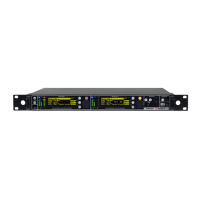
One of the milestones in the design of the MCR54 is unprecedented reliability: most of the circuitry
of the receiver is independent one from each other. Above a schematic with an overview of main
receiver functions.
RF layout:
For each antenna the RF signal is split in 4 to receiver 1,2,3 and 4 (antenna A and antenna B) with a
wide band splitter. Then 3 banks of filters are selected according to the frequency of the 4 receivers:
NOTE: the tuning frequencies of all the 4 receivers has to be in the same bank of filter!
All the 4 receivers are true diversity receivers: each one is made of two receivers tuned on the same
frequency. Subsequently the selection of the band filter between 100 kHz or 200kHz allows to work
with Narrowband (High Density) or Wideband transmitters respectively.
Each receiver has its own demodulated signal and its own RSSI signal (Receiver Signal Strength
Indication); RF squelch used measurement of RSSI level for antenna diversity and for audio enabling.
In addition to the RSSI level, each receiver measures the Channel Quality. It is a more powerful tool
than RF squelch because it actually looks at the quality of the signal from the TX relative to the noise
floor on the channel which can vary over time. With the noise squelch set to on you can set the RF
squelch to a much lower level.
A DSP selects or combines signals from section A & B to have the best audio.



 To Next Page