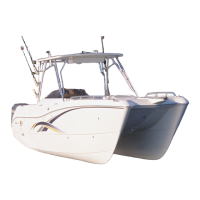
2020 World Cat 280DC-X Owner’s Manual
20
5.8 Handling Characteriscs
World Cat’s patented VectorFlo™ hull is a planing hull, which exhibits characteriscs of both planing and
displacement hulls. Planing hulls provide speed and economy of operaon since a limited amount of the hull
is in contact with the water. However, they feature at secons along the chine which can result in poor
handling at low speeds and harder impacts at high speed. Displacement hulls provide superior handling
characteriscs, even at low speed, and an improved ride in rough water. Speed and economy suer however,
since more of the hull is submerged. World Cat has taken the best characteriscs of these two designs and
incorporated them in the VectorFlo™ hull. Our proven design provides a superior ride, excellent handling
characteriscs in a variety of condions, and speed with economy of operaon. To help you experience “The
Ulmate Ride”, study the following secons.
5.8.1 Turning Characteriscs
Turning a catamaran is slightly dierent than cornering on a convenonal vessel. Imagine the dierence between
an automobile and a motorcycle. Automobiles take turns in a aer, more stable manner similar to catamaran
hulls, while motorcycles pitch hard into a turn similar to a monohull. Do not underesmate a catamaran’s cornering
ability, however; hard adjustments to the steering wheel can make a World Cat bite quickly and execute ght
radius turns. Experiment with the handling ability of your cat so you are prepared for any situaon on the water.
5.8.2 Adverse Sea Condions
Catamarans are designed to handle some of the roughest waters in the world, but that is no substute for
common sense. As an operator you are responsible for the safety of your passengers and vessel; therefore,
your trips should be limited by your level of experience. Planning and paying constant aenon to the
weather and sea condions is paramount. If you are forced to operate in dangerous seas, however, you can
be condent that your World Cat, when operated properly, can handle them safely.
Following are some ps on how to handle your boat in adverse sea condions:
• When traveling into the wind, changing your direcon a few degrees to allow one sponson
to sele before the other, can make the ride smoother and allow for increased speed.
• In a rough chop with short wave intervals, increasing your speed may allow the boat to skim
across the tops of each wave. This will result in a smoother ride.
• Steer to avoid larger swells and breaking waves.
• In a following sea, posion your vessel on the back of a wave and match its speed to remain ahead
of the trough. Speed is paramount. Work the throle to avoid going over the wave or being thrown
down the face of a following wave.
5.8.3 Cross-Clutching - Twin Engines
World Cats have their twin engines mounted 64 inches apart. This allows you to cross-clutch (one motor in
forward while one in reverse). To dock, reverse the boat into a slip: put the outside motor in reverse and turn
to face a. Keeping the wheel straight, steer with the inside motor pung it in forward and reverse to guide
you into the slip. Keep it simple and slow.
5.8.4 Get the Boat on Plane
• Trim both engines down (the motors act as trim tabs forcing the bow down).
This is a big advantage when operang in shallow water (roughly 14” dra for the 280DC-X).
• Quickly increase speed to get the boat on plane then slow down to 3500 RPM's.
• Adjust trim out unl the motors cavitate, then tap trim in.
• Feel / hear the motors and do not watch the trim gauges.
• A smooth ride is more important than having your engine RPM's synchronized.



 To Next Page