VX-8DR OPERATING MANUAL18
3
)
SCANNING
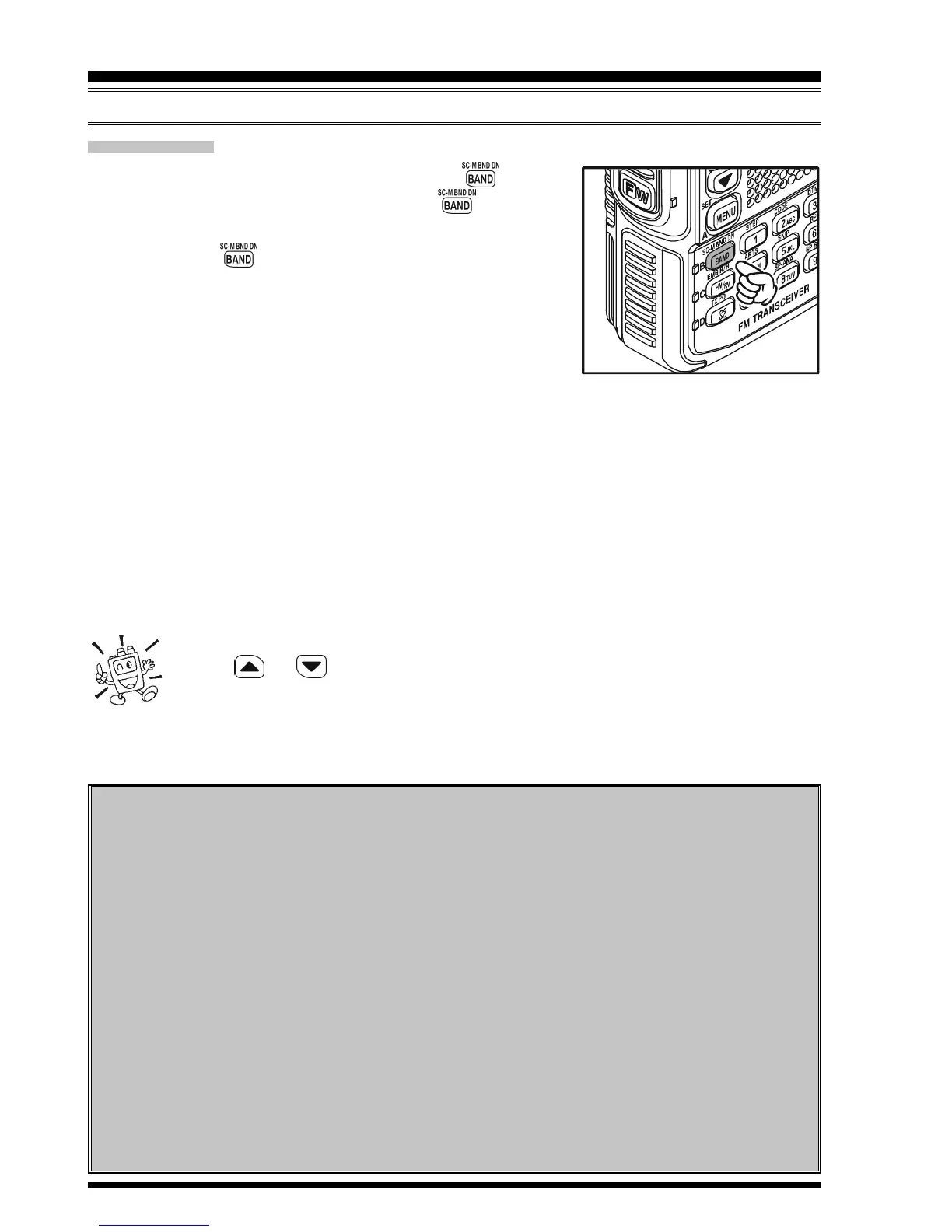
From the VFO mode, press and hold in the key for
one second, and while still holding in the key, rotate
the DIAL knob to select the bandwidth for the VFO scan-
ner. Release the key to begin scanning toward a higher
frequency. The scanner will stop when it receives a signal
strong enough to break through the Squelch threshold. The
VX-8DR will then hold on that frequency according to the
setting of the “RESUME” mode (Menu Item 83: SCAN RE-
SUME).
If you wish to reverse the direction of the scan (i.e. toward a lower frequency, instead of a
higher frequency), just rotate the DIAL knob one click in the counter-clockwise direction
while the VX-8DR is scanning. The scanning direction will be reversed. To revert to
scanning toward a higher frequency once more, rotate the DIAL knob one click clock-
wise.
Press the PTT switch briefly to cancel the scanning. See page 60 for more details regard-
ing Scan Operation.
You may initiate upward or downward scanning by pressing and holding
either or key for one second, respectively. In this case, the scanner
scans the bandwidth that was previously selected.
OPERATION
FREQUENCY NAVIGATION
Dual Receive Notice
The VX-8DR may receive very strong signals on the Image frequency, and/or the
receiver sensitivity may be somewhat reduced by the combination of the “A-Band”
and “B-Band” frequencies while Dual Receive operation is engaged.
If you experience interference that you suspect may be coming in via an “Image”
path, you may calculate the possible frequencies using the formulas below. This
information may be used in the design of effective countermeasures such as traps,
etc.
9.8304 MHz x n 11.7 MHz x n (n is an integer: 1, 2, 3, …)
4.9152 MHz x
n 6.1440 MHz x n
“A-Band” Freq. = (“B-Band” Freq. ± 46.35 MHz) x n
“B-Band” Freq. = (“A-Band” Freq. ± 47.25 MHz) x n (@ “A-Band” = NFM)
“B-Band” Freq. = (“A-Band” Freq. ± 45.8 MHz) x
n (@ “A-Band” = WFM)


 To Next Page