EasyManua.ls Logo

Yamaha TX 816 - Page 27

Yamaha TX 816
79 pages
Print Icon
To Next Page IconTo Next Page
To Previous Page IconTo Previous Page
Loading...
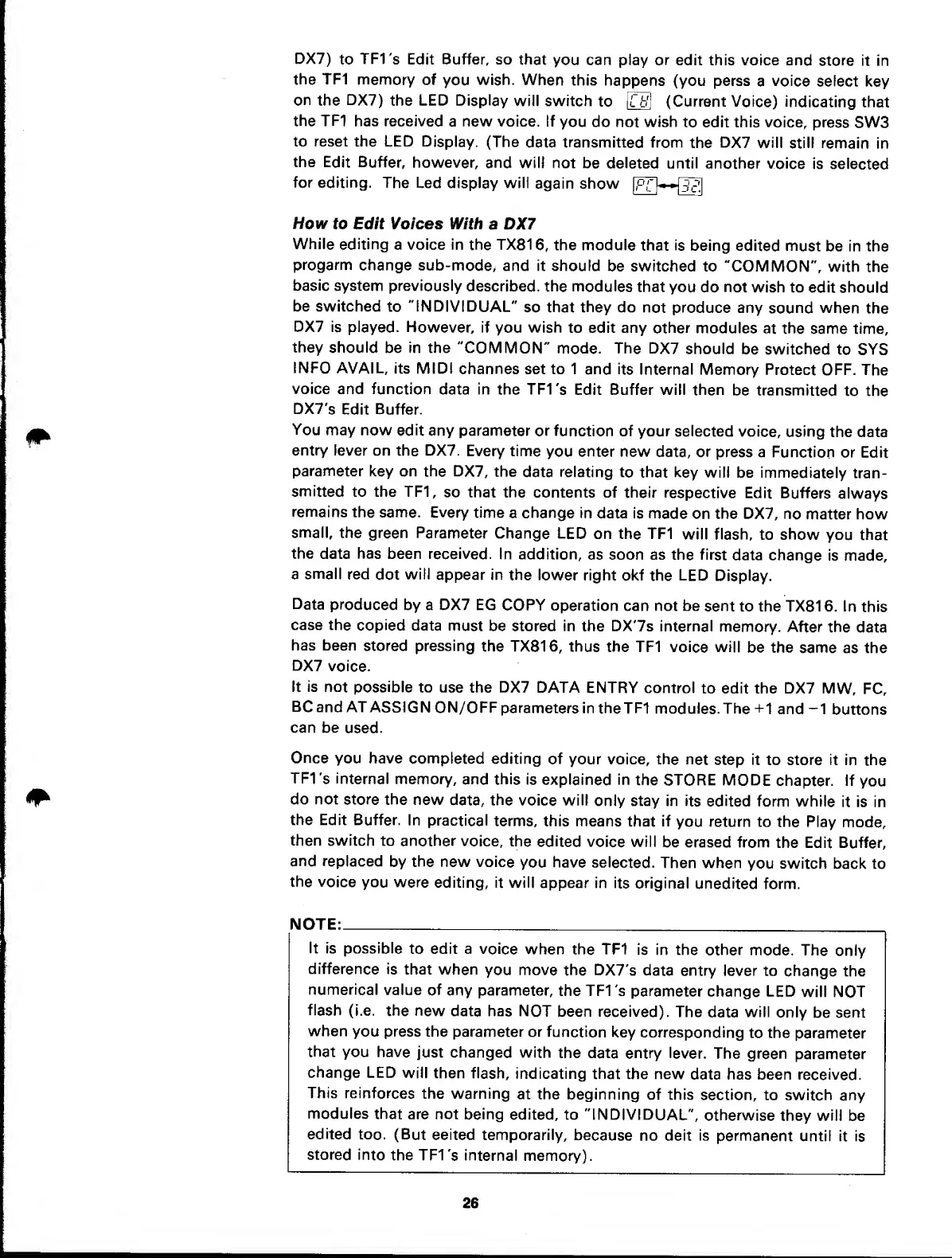
DX7)
to
TFI's
Edit Buffer, so
that
you can play or
edit this voice and
store it in
the
TF1
memory of
you
wish.
When
this
happens
(you perss
a
voice
select
key
on
the
DX7)
the LED Display
will switch
to
\CU\
(Current
Voice) indicating
that
the TF1 has received
a new voice. If
you do not wish
to edit this voice,
press
SW3
to reset the LED
Display.
(The
data transmitted from
the
DX7
will still
remain
in
the
Edit Buffer,
however,
and
will not be deleted
until another
voice
is
selected
for
editing.
The Led display will
again show
[^r]**[221
How
to Edit Voices With
a DX7
While
editing
a voice in
the
TX81
6,
the module
that is
being
edited must
be in the
progarm
change
sub-mode,
and it
should
be switched to
"COMMON", with
the
basic
system previously
described,
the modules
that
you
do
not
wish to
edit should
be switched
to
"INDIVIDUAL"
so that they do
not
produce any
sound when
the
DX7
is played.
However, if
you
wish
to edit any
other
modules
at the
same time,
they
should be in the
"COMMON"
mode.
The
DX7
should
be switched
to SYS
INFO
AVAIL,
its MIDI
channes set to 1
and its
Internal Memory
Protect OFF.
The
voice
and
function
data in
the
TFI's
Edit Buffer will
then
be transmitted
to the
DX7's
Edit Buffer.
You
may now
edit
any parameter
or function
of your selected
voice,
using
the data
entry
lever on the DX7.
Every time
you enter new
data,
or
press a
Function
or Edit
parameter
key on the DX7,
the
data
relating
to that key
will be
immediately
tran-
smitted
to the TF1,
so that the
contents of their
respective
Edit
Buffers
always
remains
the
same. Every
time
a
change
in data
is
made on the DX7,
no
matter how
small, the
green Parameter
Change
LED
on the TF1
will flash,
to show
you that
the
data
has
been
received.
In addition,
as soon as the first
data
change
is made,
a
small
red
dot
will
appear in
the
lower right okf
the
LED
Display.
Data
produced
by a DX7 EG
COPY
operation
can not be
sent to the TX81 6.
In
this
case the
copied
data
must
be stored in the DX'7s
internal
memory. After
the
data
has
been
stored pressing
the TX816,
thus
the TF1
voice will
be the
same
as the
DX7
voice.
It is not
possible
to use
the
DX7
DATA
ENTRY control
to edit the DX7
MW,
FC,
BC
and AT
ASSIGN
ON/OFF
parameters in
theTFI
modules.
The +1
and
-1
buttons
can be
used.
Once
you have
completed
editing
of your voice, the
net
step it
to
store
it in
the
TF1
's internal memory,
and this
is explained in
the STORE
MODE
chapter. If
you
do not
store the
new
data, the voice will
only stay in
its edited
form while
it is in
the Edit Buffer.
In practical
terms, this means
that if
you return
to the Play
mode,
then
switch to
another
voice, the
edited
voice will
be erased from
the Edit Buffer,
and replaced
by
the
new voice
you have
selected.
Then when
you switch
back to
the voice
you were
editing, it will
appear in
its original
unedited
form.
NOTE:
It is possible
to edit a
voice
when the TF1
is in the
other
mode. The
only
difference
is
that when
you move
the DX7's
data entry
lever to
change
the
numerical
value
of
any parameter,
the TFI's
parameter
change LED
will NOT
flash
(i.e.
the new
data has
NOT
been
received).
The
data
will
only
be
sent
when
you press the parameter
or
function
key corresponding
to the
parameter
that
you have
just changed
with
the
data entry lever.
The
green
parameter
change LED
will then
flash,
indicating that
the new
data has been
received.
This reinforces
the warning
at the
beginning
of this
section,
to switch
any
modules
that
are not
being
edited, to
"INDIVIDUAL",
otherwise
they will
be
edited
too.
(But
eeited
temporarily,
because
no deit is
permanent
until
it is
stored
into
the TFVs
internal
memory).
26