INTRODUCTION
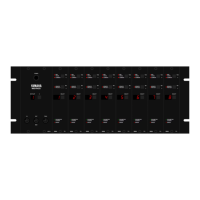
The Yamaha TX816 FM Tone Generator System basically
consists of eight
identical TF1
modules, mounted on
a
MIDI
rack
frame. This rack frame supplies the
power
to
the TF1
s,
and provides
COMMON
MIDI
IN/OUT terminals
so that all eight modules
may
be controlled by a single MIDI signal,
or
they
may
be
controlled independently.
The
TX216 contains two TFIs, mounted in the same MIDI
rack
frame,
and
you
can easily install
further
TF1s
into
the
TX21
6
whenever you like, with the possibility of building
up to
exactly the same system astheTXSI
6.
The instructions
for adding further TF1s to your TX216 are given in the section entitled ADDING
A
TF1 TO
YOUR TX216.
The
tone generating unit incorporated
into each TF1 module is equivalent to the one incorporated into the Yamaha
DX7
Digital
Programmable Algorithm Synthesizer, which has completely revolutionized the world
of
digital
music.
And, just like the
DX7,
each
TF1
contains
a
memory
bank
which
can store the
data of 32
different
1 6-note polyphonic
voices.
However,
these compact modules
are
actually
more sophisticated than a DX7, because,
as
well as being
able
to store
the 145
parameters
relating
to each voice, they can
store 25 function parameters, for effects such
as
portamento, glissando, modulation wheel
setting, and so on, which can
be
individually
set
for
each voice.
All
the
voices
and functions are available for editing and modifying,
so that on the
TX81
6
you
can have 256
different
voices, which
can be considered as
32
sets (or "combos")
of
8
voices.
This aligns
particularly well
with
the
Yamaha
QX1 Digital
Sequence
Recorder, which can store 32 banks (or "songs") each containing eight tracks of music
data.
Yamaha's FM
Digital
Synthesis technique enables
you
to
produce
amazingly lifelike
acoustic
sounds, as
well
as
the more "conventional"
synthesizer tones.
For
the user,
it
requires
a completely different approach to creating voices.
There are no
voltage controlled oscillators, amplifiers or filters
(VCOs,
VCAs
or
VCFs). An entirely
unique tone
generating technique
is used,
employing six
sine-wave "operators",
each with an envelope generator, that can
modify each
other
in billions
of ways
to
produce
the complex, moving structures that are characteristic of any acoustic
sound. A full description
of
FM Digital
Synthesis
is
given in
the DX series systhesizer owner's manuals.
All
the voices
in
the TF1 modules
are controllable using MIDI signals from the DX series
synthesizer, the
KX
series
Remote Keyboard, the
QX series
Digital
Sequence Recorder,
or
the Yamaha CX5M
Music Computer.
MIDI in-
struments
made by other manufacturers may also be used
to
control the TX816,
but
editing voices is only
possible
with
the Yamaha DX7,DX5
or
DX1
synthesizers.
Through the use of state-of-the-art
microcomputer circuitry, the wide
range of
functions
can be controlled by just
three buttons mounted
onl
the front panel of each module. Each of these buttons fulfills a variety
of functions,
and together
they control all the sophisticated circuitry
incorporated into the
TX816
and
TX216,
with
ease and
efficiency. A superb
example of Yamaha's
aim
to
make
state-of-the-art digital music technology available to all.
The TX816,
and
all
Yamaha's digital instruments, are MIDI
compatible, and may be joined together in
a
variety
of
configurations
so
that
each
unit may either drive,
or be driven by, the others. Explained in detail in
the
HOW
THE MIDI
SYSTEM WORKS chapter,
MIDI
(which
stands
for
Musical Instrument
Digital
Interface) is basically
a
universal
language that
has been created
in
order to allow digital music instruments
to
control
and drive
each other.
As the name
suggests,
digital music instruments
convert all musical information
into numbers,
which
are easily
handled
by
computer circuits,
and easily transmitted from one device to another. Using
extremely
simple
connections,
highly powerful digital music
systems may
be
easily assembled.
There are four
basic modes of operation-
-
Play,
Edit,
Store and Utility. These are selected
by
pressing the
selector
button on the
front
panel
of each module. This button is also used
to
select the
sub-
modes, of which there are
14. The
LED
Display
on
the
front
of each module shows
you at a glance which mode or sub-mode the TX816 is
using. We'll
describe them briefly
here, and in more detail in subsequent chapters.
But
first,
here's
a brief
description
of what
goes on
inside
a
TF1
module:


 To Next Page