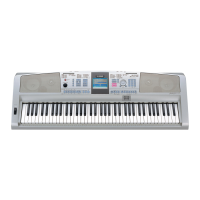
• A
VARIATION ON
SYSTEM 1 : TX816
PULS
2 DXS
DX7 #2
OUT
5-3-5—
nmrs-
31.
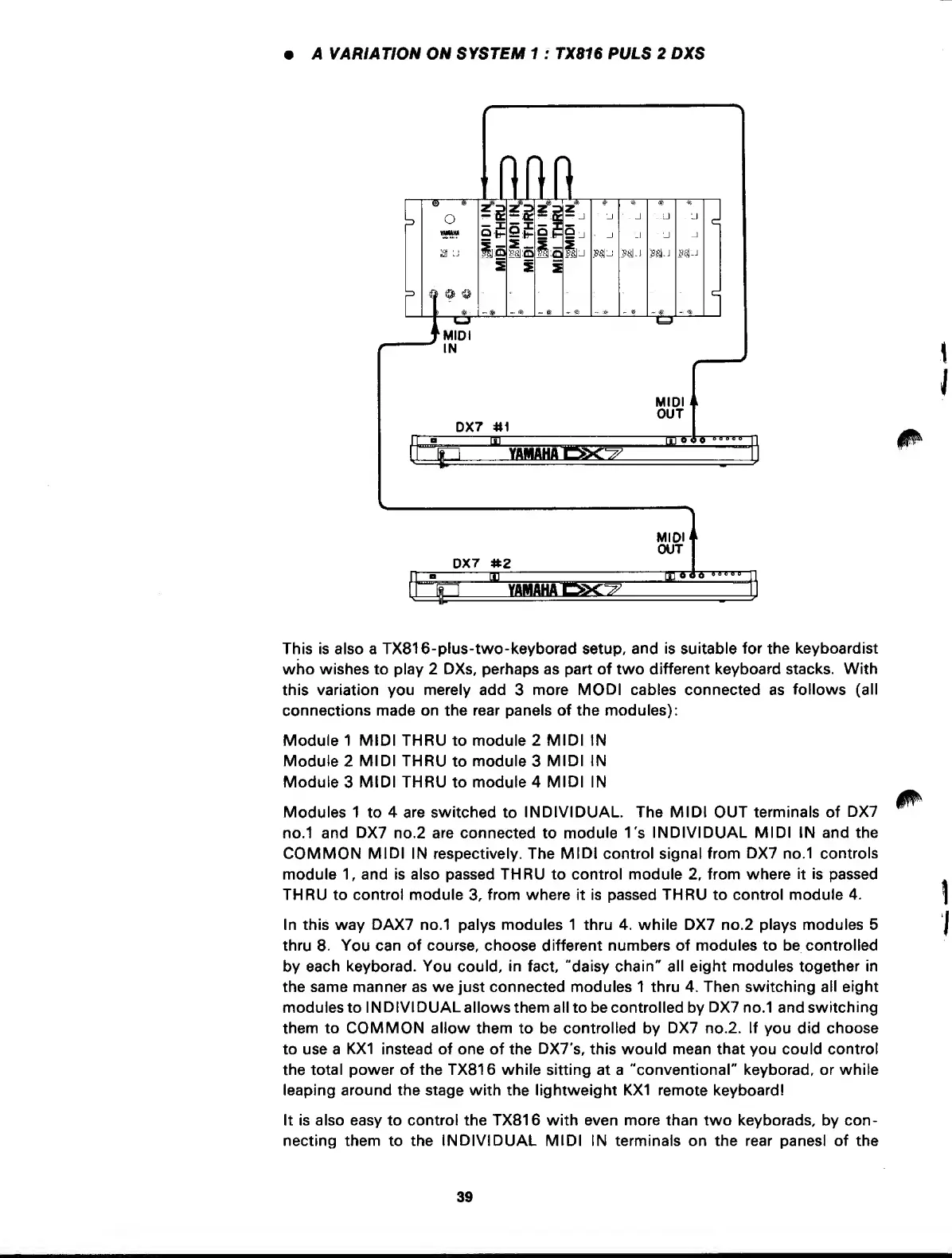
This is also a TX81
6-
plus-two
-keyborad setup,
and is suitable
for the keyboardist
who wishes to play 2 DXs, perhaps as part of two
different keyboard stacks.
With
this
variation
you
merely add
3
more MODI cables connected as
follows
(all
connections
made on
the rear panels of the modules):
Module 1 MIDI THRU to module 2 MIDI IN
Module 2
MIDI THRU
to
module 3
MIDI IN
Module
3
MIDI THRU
to
module 4 MIDI IN
Modules
1
to
4
are switched
to
INDIVIDUAL The MIDI OUT terminals of
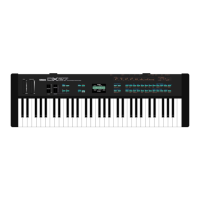
DX7
no.1 and
DX7
no.2
are
connected to
module
1's
INDIVIDUAL MIDI IN and the
COMMON
MIDI
IN respectively. The MIDI control signal from
DX7
no.1
controls
module
1,
and is also passed THRU to control module
2,
from
where it is
passed
THRU to control module
3,
from where it is passed THRU to control module
4.
In this way DAX7 no.l palys modules 1 thru 4, while DX7 no.2
plays
modules 5
thru 8. You can
of
course, choose
different numbers
of
modules to be controlled
by
each keyborad. You could,
in
fact,
"daisy
chain" all
eight modules together
in
the same manner as we just connected modules 1 thru 4. Then
switching all eight
modules to
INDIVIDUAL
allows them all to be controlled by
DX7
no.1 and
switching
them to
COMMON allow
them
to be
controlled
by
DX7
no.2.
If
you
did
choose
to use a KX1 instead of one of the
DX7's,
this would mean that you could
control
the total power of the TX816 while sitting
at a
"conventional" keyborad, or while
leaping around the stage with
the
lightweight KX1
remote keyboard!
It is also easy to control the TX816 with even more than two keyborads, by con-
necting them to the
INDIVIDUAL
MIDI IN terminals on the rear panesl of the
39


 To Next Page