35
Mod. ITACA-TROIA rev 01
Installation
translated from the original text
IT IT
FR
FR
ES ES
EN EN
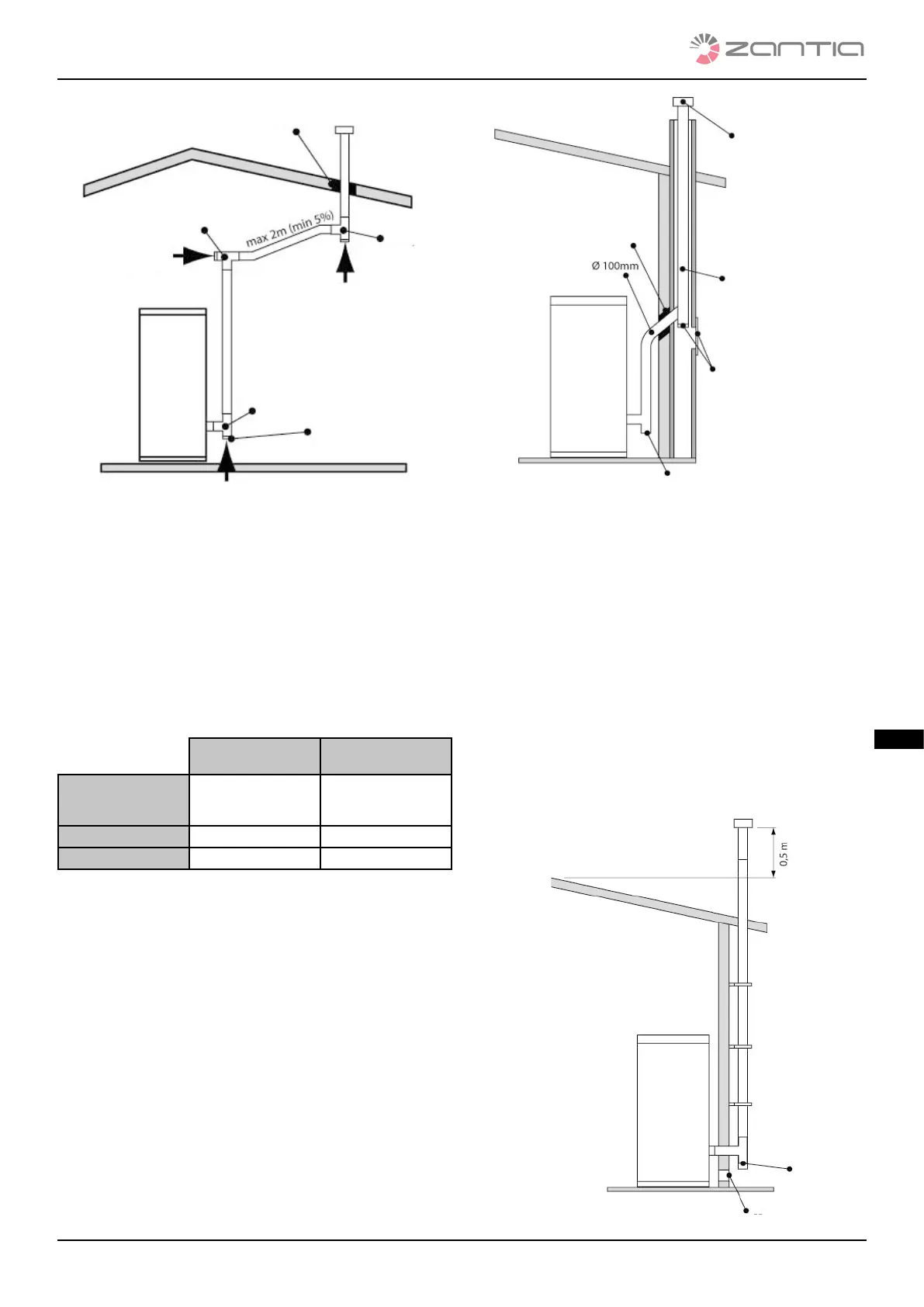
g. 11 pipe length
2.5.8 BORES FOR PASSAGE OF EXHAUST PIPE ON
WALL OR ROOF: RECOMMENDED INSTALLA
TION AND DIAMETER
Once the position of the boiler has been established (par.
2.5.6), a hole must be drilled for passage of the ue gas ex-
haust pipe. This varies according to the type of installation
(and of the exhaust pipe diameter) and on the type of wall or
roof. The insulation material must have mineral origin (rock-
wool, ceramic bre) with a nominal density exceeding 80 kg/
m3.
Insulation thickness
[mm]
Diameter of the
holes [mm]
Wooden wall, or
anyway ammable or
with ammable parts
100 300
Cement wall or roof 50 200
Brick wall or roof 30 160
tab.4 bore diameter for exhaust pipe passage
2.5.9 USING A TRADITIONAL FLUE
If you wish to use an existing ue, we recommend having
it checked by a professional chimney sweep to ensure that
it is fully airtight. This is because the ue gas, being slightly
pressurised, can inltrate into possible cracks in the ue and
invade the living areas. Should the ue not result in perfect
conditions after the inspection, it is advisable to have it sealed
with new materials. In the event of a large-size existing ue,
we recommend inserting a pipe having a diameter of maxi-
mum 150 mm; it is also advisable to insulate the ue gas ex-
haust pipe. The following gures describe the solutions to be
chosen in the event an existing ue is used
Insulation
Tee tting
Tee tting
Airtight cap
Tee tting
Cleaning
direction
Cleaning
direction
Cleaning direction
.
g. 12 traditional ue
2.5.10 USING AN EXTERNAL FLUE GAS DUCT
AN external ue gas duct can be used only if it meets the fol-
lowing requirements:
• Only insulated (double-walled) stainless steel pipes must
be used fastened to the building (following g.).
• An inspection must be provided at the base of the duct
to carry out periodic verications and maintenance opera-
tions.
• It must have a wind barrier chimney and respect the "d" dis-
tance from the ridge of the building as shown in par. 2.4.3, tab.
1.
• The following gure shows the solution to be chosen in the
event an external fuel gas duct is used (ref. UNI10683).
Chimney
Insulation
Inspection
doors
Max Ø 150
Tee tting
Inspection
Air intake with non-lockable grille



 To Next Page