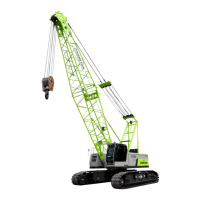
RT100 Rough Terrain Crane
fast and can cause damage to the drive train.
(4) Obey the items in the table. Stop the crane when you are at one of the limits in the
Running Interval 4 Hours 2 Hours
Cooling Time 1 Hour 30 Minutes
E. Charge the Battery Before You Stop the Engine
Before you stop the engine, idle the engine for an interval of time. Stop the engine when
the battery has a full charge.
When it is necessary to stop the engine, operate the engine at idle speed (with no load
on the engine), for minimum 5 minutes. This lets the engine coolant temperature
decrease gradually before the engine stops. This cool down period is very important for a
crane with a turbocharged engine. This is because the turbocharged engine makes more
heat than an engine that does not have a turbocharger. When the engine indicators and
gages are at the correct level, stop the engine. Move the ignition switch to the “OFF”
G. Move the Crane at the Job-Site
Before you move the crane on the job-site, make sure that there is clearance to prevent
injury to personnel or damage to the crane and other objects. Obey the items that follow
before you move the crane:
(1) The boom must be in the front of the crane.
(2) Engage the swing lock.
(3) Secure the main hook to the bumper loop or put the hook block near the boom head
(4) Make sure that you fully retract the outriggers.
(5) Do not move with the boom above horizontal unless the surface is hard, level and
(6) Look for overhead blockages such as trees, power lines or bridges.
(7) When the terrain is not smooth, move at a slow speed.
(8) Do not side move the crane on a slope that is more than 15°.
(9) Can be done within permissible angles with caution.
The engine and transmission lubricant in the tanks moves to one side. You can
cause damage to the engine or transmission.



 To Next Page