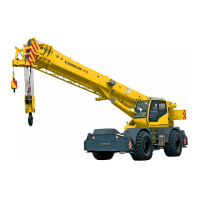
RT100 Rough Terrain Crane 07 -
49
You can side move the crane on hard surfaces with a slope less than 15°.
When on rough terrain surfaces, the slope angle must not be more than 5°.
The boom must in the front, at 0° to -3°.
Refer to the ON TIRES LIFTS procedure when you move a load.
7.21 ON TIRES LIFTS (CREEPING A LOAD)
A. Special precautions for On Tires lifts when moving a load.
(1) The boom must be in the forward position.
(2) Move the load at a slow speed.
(3) Make sure that the tire pressure is at the correct level.
(4) Do not make sudden stops or starts.
(5) Use tag lines. Do not let the load move around.
(6) Keep the load near the ground.
(7) Engage the swing lock.
(8) You must only move the travel on a hard surface. It must hold the weight of the
crane and the load. The travel surface must also be free of holes or unwanted
material that can cause the crane to tilt.
These precautions are necessary to prevent the pendulum effect. This can cause
Obey all the safety precautions. Do not move a load in the “ON TIRE”
mode if the pressure in the tires is not correct. When the pressure in
the tires is low, you must decrease the load. You can cause damage to
the tires and wheels, or tilt the crane, if you try to lift a load that is too
Hydraulic oil temperatures that are too high cause rubber components
(hose, O-rings, etc.) to fail. If hydraulic oil in the tank temperature
increases to 176℉ (80℃), decrease the time of the lift. Stop the
operation to prevent a rise in the hydraulic oil temperature.
When you move a load in the “Creep” mode, the maximum speed is 1.6
km/h. Stop and wait for 30 minutes after you move 60 ft. (18 m) to
prevent overheating the tires.



 To Next Page