Original Instructions Rev.1.0 User Manual – Isa 30/ 42
Theoretical Basics of Centrifugation
Basics
Relative Centrifugal Force
In customary practices and usages of centrifugation, the quantization unit of angular velocity (denoted N), is the revolution
per minute (abbreviated rpm, RPM, r / min, or r • min-1). This is a measure of frequency of rotation. It corresponds to the
number of full rotations completed in one minute around a fixed axis.
The derived frequency unit for SI units is Hertz, with the symbol Hz. Its expression in terms of SI is s-1.
Laboratory centrifuges are used to separate solids of different densities in suspension, applying the relative centrifugal
force (RCF for short) on samples. The effective force increases with the square of the rotational speed and distance from
the axis of rotation. This force, known as "g-force" is quantified as the number of "g" applied to the sample. No SI units are
provided.
The following formula is used to convert the angular speed to "g-force"
RCF Relative Centrifugal Force, "g"
N: angular velocity, revolutions per minute
r: radius of the circular path of the sample, mm
g: acceleration of standard gravity, 9806 65 meters per second per second (ms-²)
The relative centrifugal force depends on the speed and the rotation radius.
An approximation, denoted F, is used in practice to calculate the value of the relative centrifugal force:
Speed, based on the relative centrifugal force is calculated by the following formula:
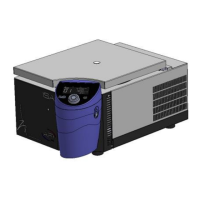
Integral spin
It is the accumulated relative centrifugal force acting on the centrifuged object at the corresponding time.
It is outlined by the colored surface of the chart below.


 To Next Page