BEFORE SYSTEM INSTALLATION
The maximum length of standard plastic fiber optic cable that may be used is 250 feet or
76 meters. Proper fiber end termination; cleaving and polishing, is necessary to obtain
this length.
Transmit TX/FO on the Controller connects to Receive RX/FO on a BASE/PLUS UNIT. Transmit
on this base/plus unit connects to Receive on the next base/plus unit, and so on until Transmit
on the last base/plus unit returns to Receive on the Controller.
IMPORTANT NOTE:
Unlike the requirement for connecting base/plus units to battery strings, the string and
address assignments on the nameplates do not determine the order in which base/plus
units are connected within the fiber optic ring.
Look at the system drawing and the physical facility and determine how the fiber optic and
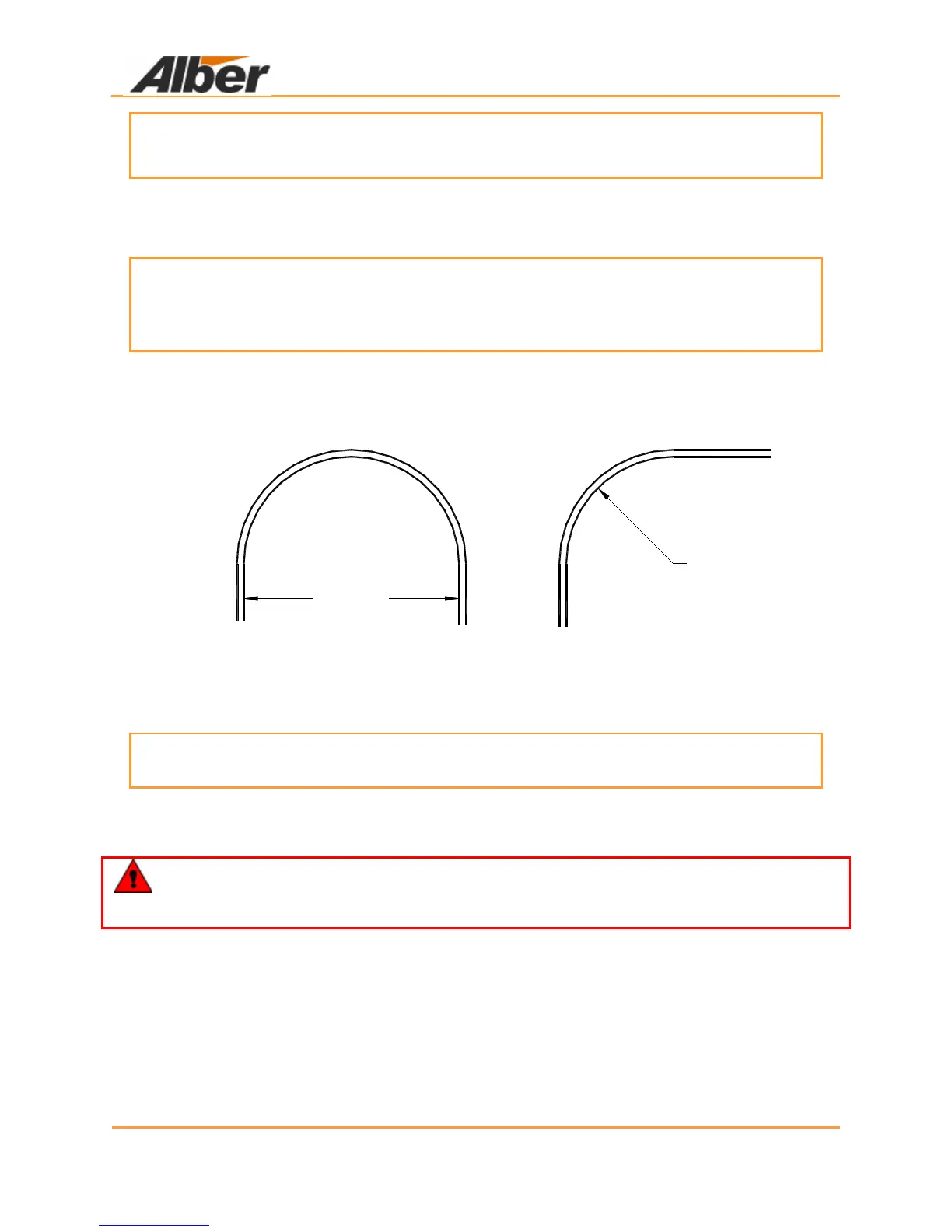
power cables to the BASE/PLUS UNITs must be situated. When installing the fiber optic cable,
do not bend the cable in a radius tighter than 35mm.
70mm
Diagram Not To Scale
r35mm
Figure 29. Minimum Bend Radius Of Fiber Optic Cable
NOTE:
Use KIT–3703–015 to terminate fiber optic cable correctly.
6.3.4 Sense Lead Harness Routing From BDS–40 To The Battery
The installer normally determines the wire routing.
WARNING:
Do not route the wires in the same conduit as other wires in the facility.
A Panduit slotted cable tray with cover or equivalent is normally used to distribute wires to the
cells.
6.3.4.1 Conduit
Conduit can be used to route harnesses from the BDS components to the battery rack and to a
wire tray to distribute the wires to each cell.



 To Next Page