PAGE 16 AR7030 OPERATING MANUAL
Used to backspace frequency entry from
the right hand side, each additional press
of this key deletes one further figure. This
is useful for correcting a mistake without
the need to re-enter the whole frequency.
Frequency entry using the infrared controller is accepted
in the range 0.051 MHz (actually 50.977 kHz) to 32 MHz
(actually 32.01672 MHz). Frequencies above the specified
top limit up to about 44 MHz will result in the receiver
tuning to the top frequency limit just above 32 MHz.
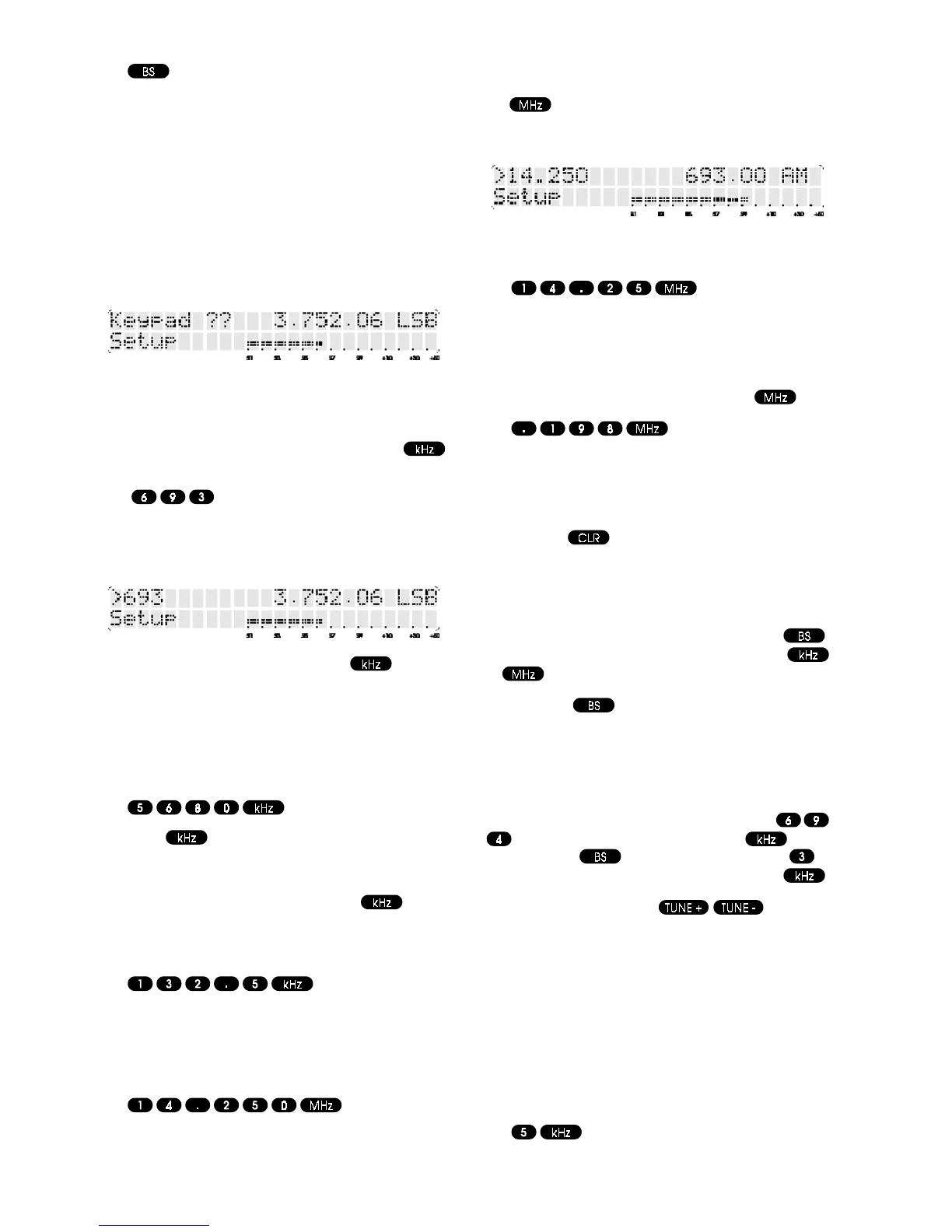
Incorrect frequency entry usually results in an error
message Keypad ?? being displayed in the top left corner
of the LCD.
You cannot key in a frequency of 50 kHz or less to tune
the receiver. Instead this is how the tuning keys’ step size
is set.
Examples: An example frequency entry using the
key of 693 kHz (0.693 MHz), as follows:-
As the frequency is entered through the keypad, the digits
are displayed in the top left hand corner of the LCD, to
the right of a > symbol.
When the entry is completed using the key, the
frequency transfers to the main VFO frequency readout
of the LCD and the top left display returns to its previous
state.
Another example of frequency entry for the international
search and rescue frequency 5680 kHz (5.680 MHz)
would be as follows:-
When the key is used, the AR7030 automatically
calculates where the decimal MHz separator should be
inserted.
It is possible to enter frequencies using
and a
decimal point for hundreds and tens of Hz. This may be
useful for certain data communications applications such
as FAX. For example, to tune to 132.5 kHz type:-
As frequency increases past a few MHz, it becomes more
natural and easier to enter frequencies directly in MHz.
An example frequency entry of 14.250 MHz (14250 kHz)
would be as follows:-
As the frequency is entered through the keypad, the input
is displayed in the top left hand corner of the LCD, to the
right of a > symbol. When the entry is completed using
the
key, the frequency transfers to the main VFO
frequency readout of the LCD and the top left display
returns to its previous state.
It is not necessary to add leading or trailing zeros to any
frequency. Entry of 14.250 MHz may alternatively be:-
The three trailing zeros will be added automatically to the
display by the AR7030.
Similarly, when frequencies below 1 MHz are entered, it
is not necessary to precede with zeros. To enter a
frequency of 0.198 MHz (198 kHz) using the
key:-
The preceding zeros are assumed by the AR7030 and
trailing zeros added automatically.
Cancelling frequency input: At any time during frequency
entry via the keypad, the process may be aborted by
pressing the
key. Any input displayed in the top
left corner of the LCD is cancelled and the displayed
reverts to its previous state.
Correcting frequency entry during input: Should a
mistake be made while entering frequency via the keypad,
it may be corrected using the back-space key
.
However, the entry cannot be corrected once the
or keys have been pressed.
Each time the
key is pressed, the frequency entry
(progress is displayed in the top left of the LCD following
a > symbol) is deleted from the right-most digit (the last
one entered). Each additional press of this key deletes
one further digit. This is useful for correcting a mistake
without the need to retype the whole frequency.
For example, if the entry has been mis-typed as
and the mistake realised before the key is
pressed, press
to delete the figure 4. Enter to
replace it, then complete the process by pressing
.
c. Tuning step keys
Occasionally it is convenient to tune up and down the
frequency spectrum in specific step sizes such as 5 kHz
for short wave, 9 kHz for European medium and long wave
or 10 kHz for US medium wave. The step tuning facility
also makes fine tuning sprawling amateur band nets easy
when the receiver is just out of reach.
First the tuning step size needs to be defined and this is
achieved using the numeric keypad. For example, to select
a tuning step of 5 kHz from the from the infrared controller
type:-


 To Next Page