ARTURIA – CS-80V – USER’S MANUAL
45
5.9 THE PEDALS
The original CS-80 was a synthesizer possessing all of the functions of a real playing
surface. A number of settings and possibilities of expression and sustain are explained
below.
Expression pedal
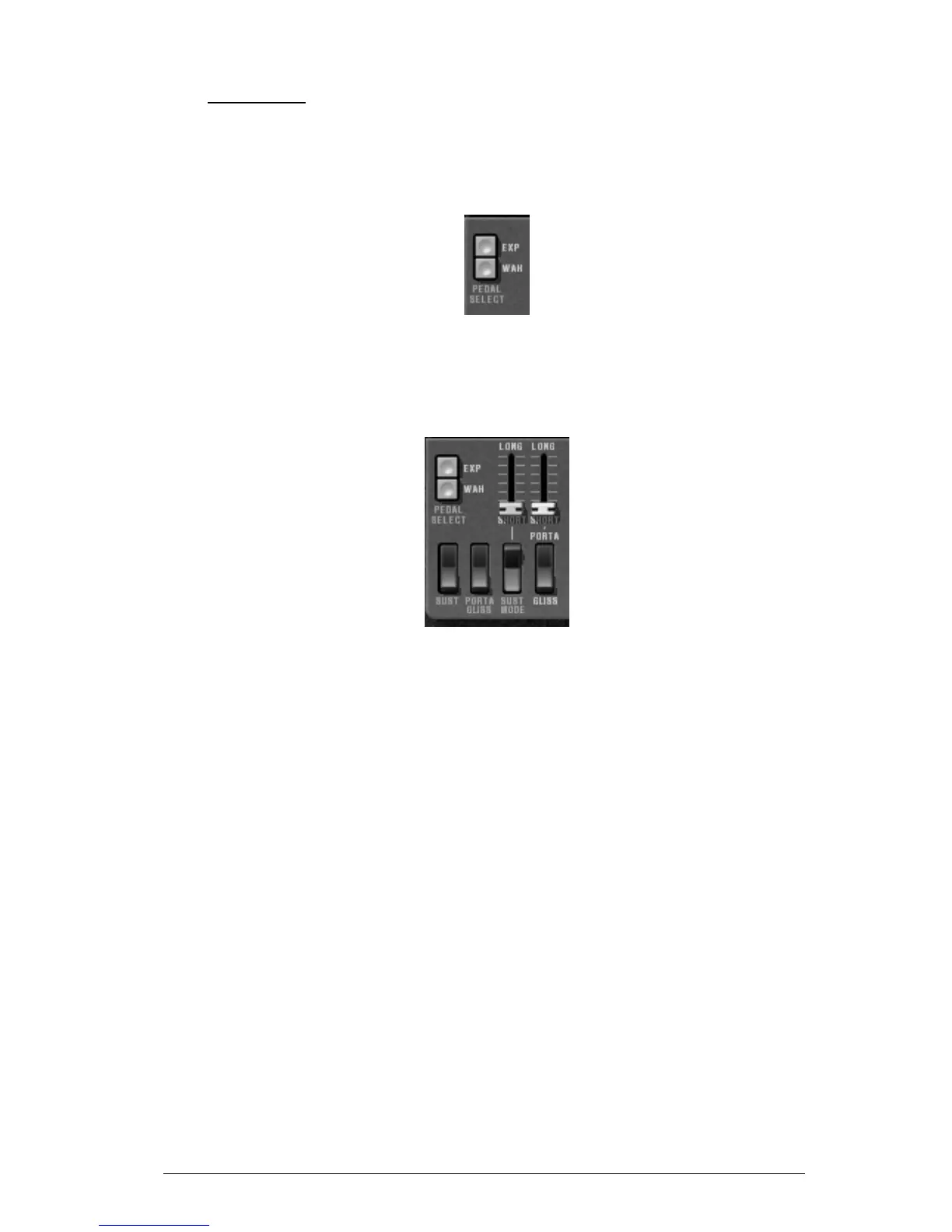
The «EXP» and «WAH» buttons, when activated, allow the use of a pedal expression
MIDI message (Control number n°4) either on the amplification of the volume
(expression), or on a sweeping filter (wha-wha).
Portamento and sustain pedal settings
The «PORTA» fader allows the control of a portamento on notes. This means that for a
given polyphonic voice, when a new note is activated, the frequency of the VCO will
gradually move from the frequency of the previous note to the frequency to the currently
held note.
When the «GLISS» switch is at the high position (Off), the passage will be done
continuously, at the low position (On) it will be done by semi-tone.
When the play mode of the zone is «CSASSIGN» (see §5.14), then the portamento
transitions from note played at least 200 ms before.
It is possible to enable or disable the portamento for each voice ( see §5.14).
When the «PORTA/GLISS» switch is at the low position (On), the choice between the
portamento (continual variation) and the glissando (variation by semi-tone) is controlled
by MIDI messages corresponding to the sustain pedal.
The fader above the «SUST MOD» switch sets the sustain time. When the «SUST» switch
is at the top (Off), sustain time is given by the fader setting. When it is set to the bottom
(On), sustain time depends on the MIDI messages from the sustain pedal. When the
pedal is off, there is no sustain, when it is on, sustain follows the fader setting.
The two positions of the «SUST MOD» switch allow standard functioning (switch off,
towards the top), or mode where the sustain is interrupted when a new note arrives
(switch on, towards the bottom).



 To Next Page