ARTURIA – CS-80V – USER’S MANUAL
60
7 SOME ELEMENTS OF SOUND DESIGN
Here is a series of examples designed to guide you through the creation of various
sounds as well as a vintage analog styled note sequence. They progress in order of
difficulty going from the easiest to the most difficult and are organized into 3 parts:
The first part will help you to grasp subtractive sound synthesis. You will start with
the most basic patch (make a VCO oscillator «ring» in an output VCA amp), to finish
by touching on the programming of a more rich sound (several VCO sources, VCF
filters, VCA envelopes…)
The second will help you to use the Multi mode and the arpeggiator.
The third will give you tips on creative use of key follows, and creating a stereo sound
without the use of additional chorus and delay effects.
7.1 SUBTRACTIVE SOUND SYNTHESIS
7.1.1 A basic sound
To begin we will see how to program a basic sound. As we saw in chapter 3 (Quick
Start), the CS-80V uses two identical and independent lines of synthesis. We will only
use the first (the one above) for this example. It will be simply composed of:
an oscillator
a low pass filter
an output VCA
the envelope corresponding to the output VCA.
You will thus obtain the base patch for subtractive synthesis.
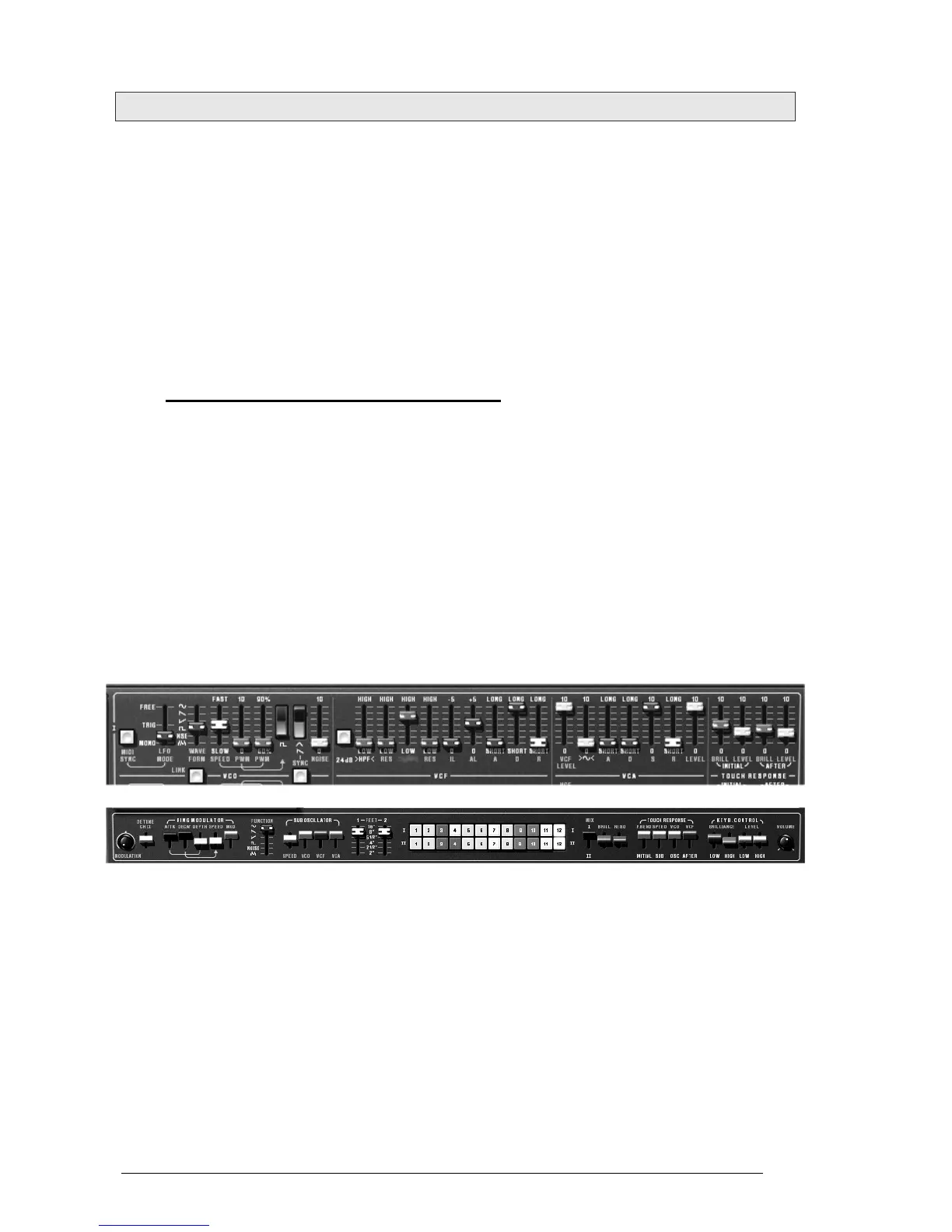
The following image shows the different slider/lever positions:
Choose the preset «1_line» in the «templates» bank, sub bank «temp_syn».
This sound uses a saw tooth waveform, the high pass filter is «closed» (but not
deactivated), while the low pass is completely «open». The amplifier envelope has a
minimum attack time («A») as well as a short release time («R»).
This minimalist configuration will let you easily perform some simple experiments with
this basic sound.
Start by progressively lowering the cut-off frequency of the low pass filter. The sound
becomes more and more «soft».
Increase the frequency of the high pass filter. You will hear the sound lose its low
frequencies (to clearly hear this effect, make sure not to set the cut-off frequency of
the low pass filter too low as the sound will be too soft !)



 To Next Page