ARTURIA – CS-80V – USER’S MANUAL
52
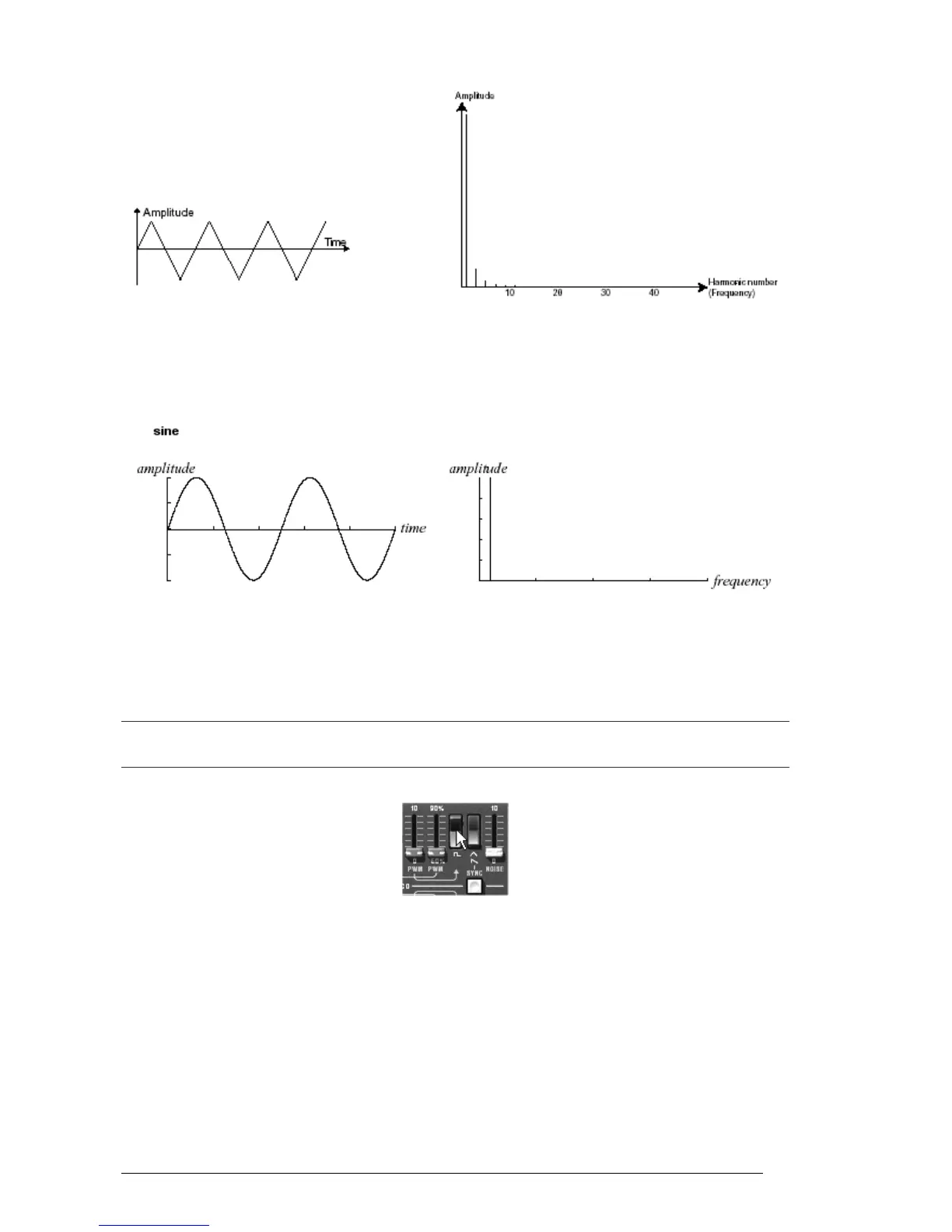
The sinusoid is the purest of all. It is a unique harmonic and produced a very
«damped» sound. It can be used to reinforce the low frequencies of a bass sound or
as a frequency modulator in order to create harmonics that don’t exist in the original
waveforms.
PWM (Pulse Width Modulation) is a setting that allows you to modify the waveform cycle
(or wave length). This can be done manually with the help of a knob «PW» or by
modulation (with an envelope or LFO). This impulse width variation translates to a
spectrum modification, resembling a waveform change.
Unlike many other classic analog synthesizers, the CS-80V lets you change the impulse width not only for the
square waveform but also for the triangle.
This brings a large number of additional sound possibilities to compliment the base signal.
The CS-80V waveform
The synchronization of an oscillator with another creates more complex waveforms. If
for example, you synchronize oscillator2 with oscillator1, oscillator2 will restart a new
period every time the first oscillator completes a period, even if oscillator2 has not
completed a complete period (this signifies that it is not tuned to the same tonality!) The
more you tune oscillator2 upwards, the more you will encounter composite waveforms.



 To Next Page