•
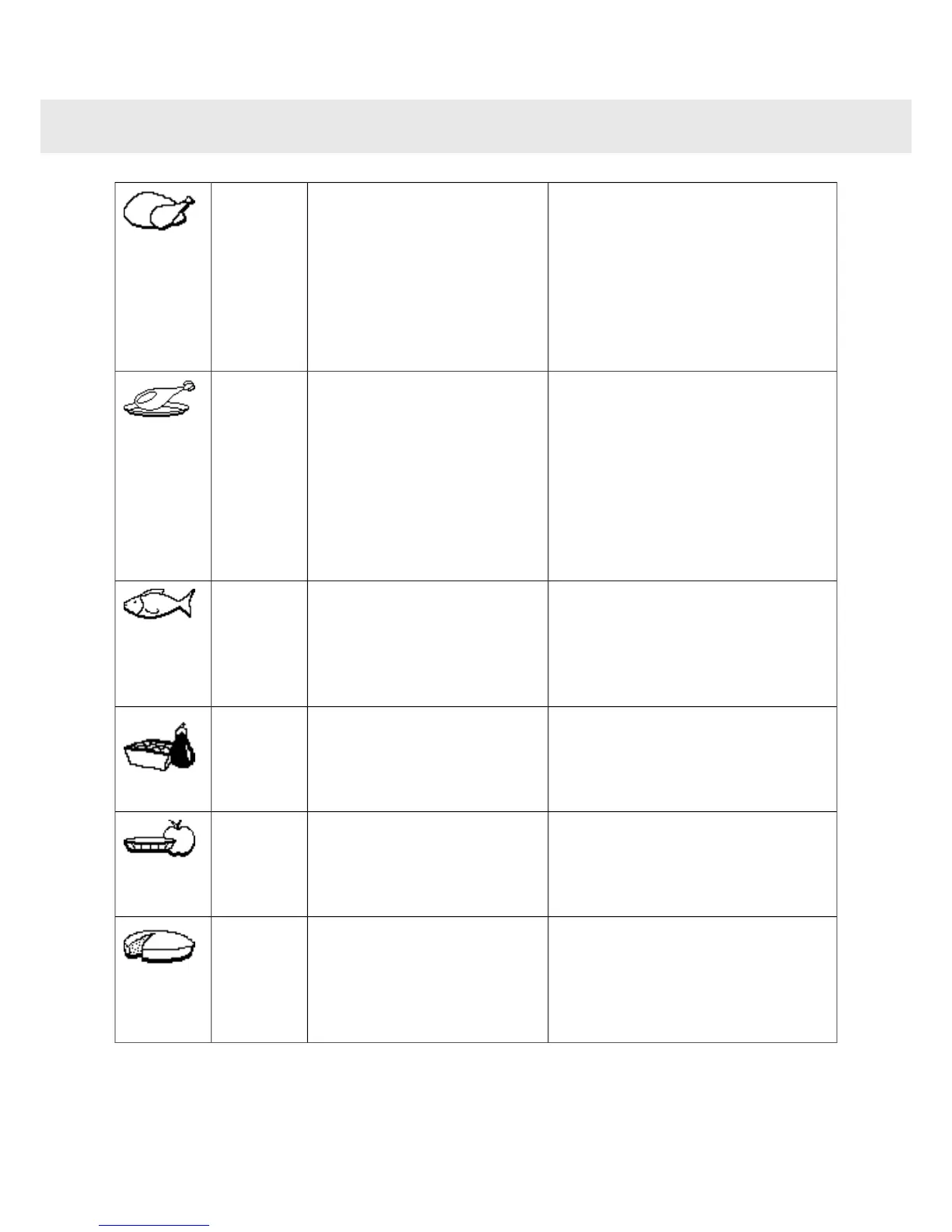
Cooking on the spit: don't forget to
place the dripping pan on the first
level to catch all the fat.
•
Cooking in a dish: you should use
earthenware dishes to avoid spatter-
ing.
•
Pierce the skin of poultry to avoid
spitting.
•
Chicken weighing 1 to
1.700kg
•
Duckling, pheasant etc
Chicken
•
Remove the meat from the refrigerat-
or a minimum of one hour before
cooking:
•
Choose a round and plump leg of
lamb rather than one which is long
and bony. Use an earthenware dish.
•
Allow the meat to stand after cooking
with the leg of lamb wrapped in a
sheet of aluminium paper.
•
Leg of lamb: 1 to 2.5kg
•
Place on the shelf (in the
shelf/dripping pan as-
sembly).
Lamb
•
This function should only be used for
whole fish, cooked with herbs and
white wine. (Grilled fish or fish
cooked in tinfoil require the oven to
be preheated).
•
Whole fish
(Bream, cod, trout, mackerel,
etc)
•
Fish roast
Fish
•
Take care to adapt the size of your
dish to the quantity to be cooked in
order to avoid the juices from over-
flowing.
•
Stuffed tomatoes, peppers,
etc
•
Lasagne (fresh or frozen)
•
Cottage pie, etc.
Vegetables
•
Use a non-stick aluminium flan tin:
the pastry:
•
The pastry on the bottom will be
crisper.
•
Fresh tarts
•
Frozen tarts
Sweet tarts
•
Cakes prepared in a cake tin (round
or square)… and always placed on
the oven shelf.
•
It is possible to cook two cakes in tins
side-by-side.
•
Family cakes (sweet or sa-
voury), Pound cake
•
Pre-packaged cake mixes
Cakes
21
Using the various cooking modes


 To Next Page