18
4.3.3 Compressed-air system (option)
) Prior to each application, proper function of the display
instruments and control valves must be checked!
Purpose of compressed-air system:
a) Medicaments can be applied to the nasopharynx:
• The pump for the compressed-air system switches on
after the compressed-air handle has been removed from
its holder.
• Handle is mounted on a sprayer. The top of the
compressed-air handle locks in place in the ring of the
sprayer bottle.
• Available sprayers:
- with straight spraying tube for normal liquid
medicaments
- with twin tube and adjustable angular jet for oily
medicaments.
) If a sprayer is used with medication the instructions of the
medication manufacturers have to be observed.
) Do not use the sprayer for the storage of medication!
) Caution to be paid to avoid injury when introducing
sprayer jet!
Please note, in case the ventilation opening is blocked or
thesprayerheadisimmersedinuids(e.g.blood,secretion,
etc.)anegativepressurecouldoccurandtheuidcould
owbackintothebottle.
Inthiscasethemedicinesprayer,sprayerhead,exible
nozzle as well as the hose piece for the medicine sprayer
must be reprocessed as described in chapter 5.0 cleaning.
• Pull the release lever.
ª The medicament sprayer is supplied with air and the
medicament in the sprayer bottle is atomized.
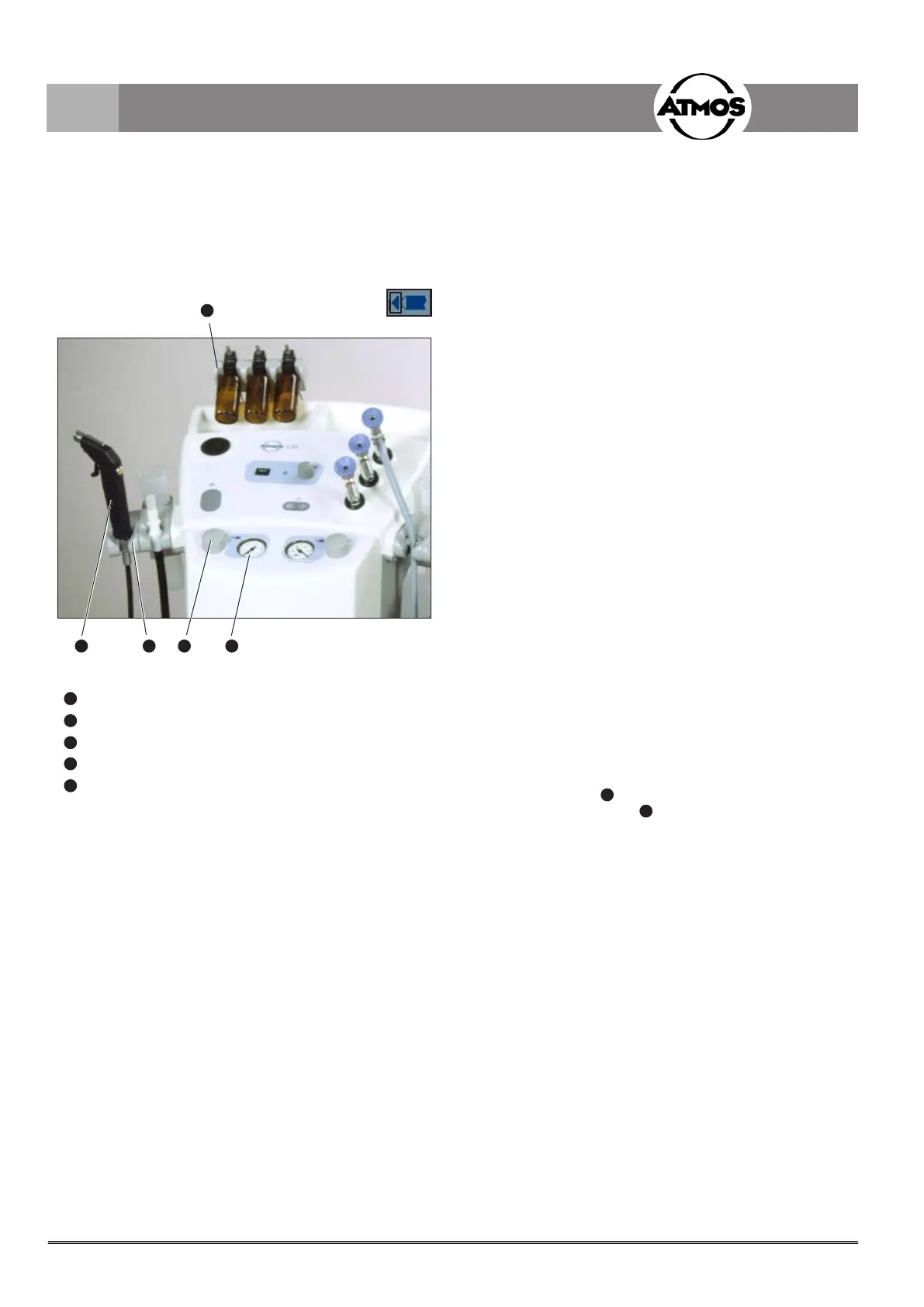
• The amount of compressed air is adjusted with
the control knob (
3
,g17)inconjunctionwiththe
compressed air gauge (
2
,g17).
• After use, the medicament sprayer is again inserted in its
holder, the bar is pressed, the handle is removed from
the sprayer and again inserted in its support.
ª Compressed-airsystemisagainswitchedo.
) For hygienic reasons, the spraying tubes are to be
exchanged following each application or with each
patient.
Fig. 17. Compressed-air system
Sprayer suspension
Compressed-air display
Compressed-air control
Support for automatic photoelectric barrier control
Compressed-air handle
4.0 Operation
1
2345
1
2
3
4
5


 To Next Page