Atomos Ninja-2 – User Manual Edition 1: November 2012 10
Using the Ninja-2
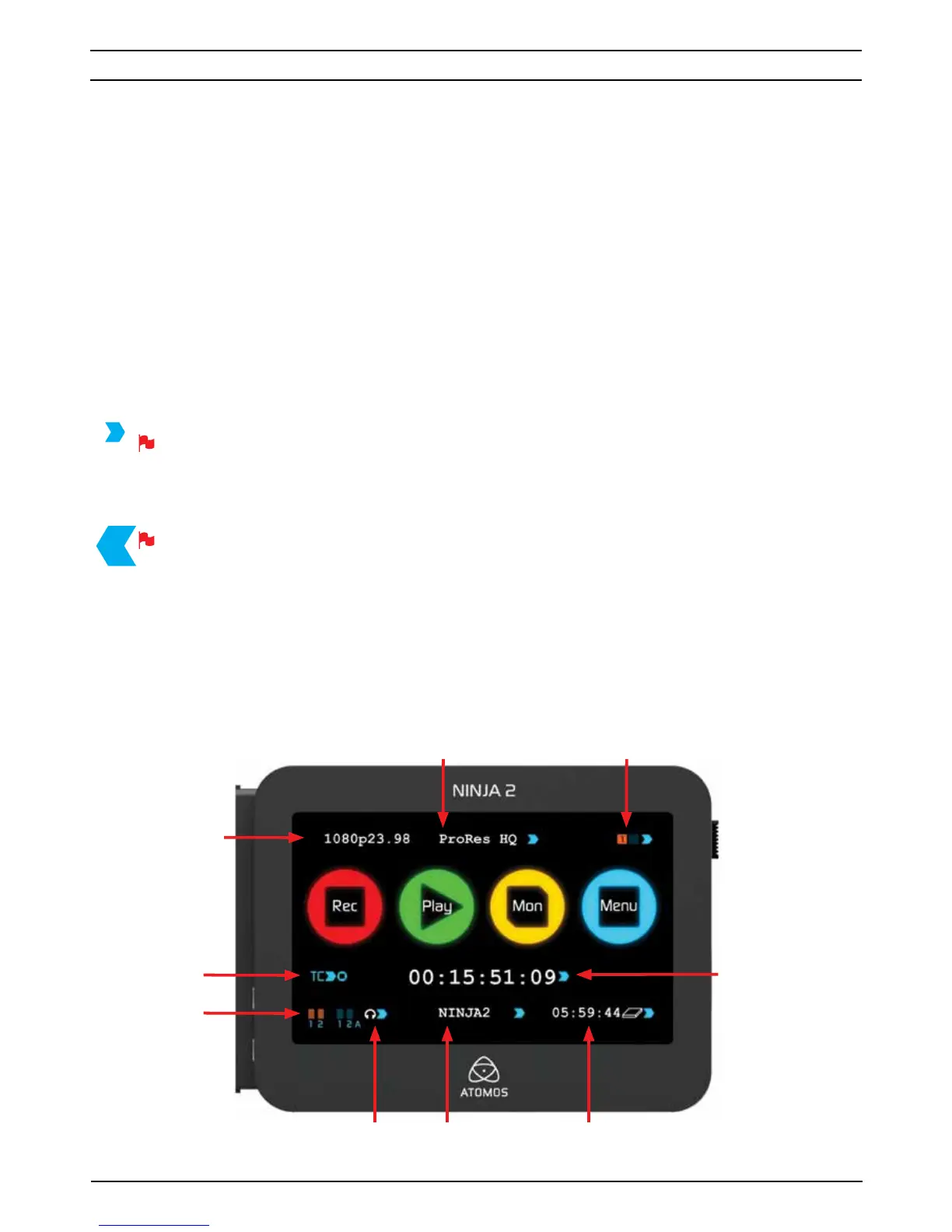
The Ninja-2 is controlled via an intuitive touchscreen interface. There are
large, obvious controls for Record, Play, Monitor, and Menu, as well as
the following information:
• Current input format and status
• Codec currently in use
• Remaining battery power
• Which of the two batteries is currently active
• Headphone/Line Out volume
• Audio Input Level meters
• Remaining Recording time on disk
• Timecode
• Record Trigger
• Unit name
Watch out for any items on the screen that are marked by a
small blue arrow. If you touch these items you will be taken
to other options depending on context. If you touch them
repeatedly, you will cycle through related options
A large blue arrow in the top right of the screen will
take you out of lower-level menus back to the main
control screen
The User Interface in detail
Even though the Ninja-2 is an extremely sophisticated and technically
advanced device, we have taken a minimalist approach to the interface.
We’ve only included controls that you really need. This is important in
a device that has to be ready for use at all times and must therefore be
simple to operate while in use.
The Ninja-2 Touchscreen
Ninja-2 features a very high quality 800x480 pixel video touch screen.
Most of us are now familiar with the idea of touchscreens, but there is an
important difference between Ninja-2’s screen and those you might find
on a smartphone.
Ninja-2’s screen is pressure and touch sensitive. It takes more than a
glancing brush of a finger to trigger the screen. For some applications,
(like dragging and dropping) this would be a disadvantage, but for the
Ninja-2 it is an important feature, because if the screen was too sensitive,
it would be easy to accidentally trigger Ninja-2 operations, potentially
interrupting a recording, for example.
With the Ninja-2 screen, you have to firmly push the screen for an
instruction to register. This gives a very positive feel to the device and
confidence that commands won’t be given in error.
Be definite and deliberate in your pressing on icons on the screen and
the Ninja-2 will be very responsive. Remember this is not a capacitive
touch device like many Smart Phones; holding contact with the icon for a
millisecond will ensure accurate and rapid response.
The Home Screen
This is the screen you see whenever you are not in a function or sub-menu,
and it is the first screen that the Ninja-2 boots into when you turn it on. All
functions are one touch away: simply touch the screen on any function to
be taken to that function’s screen.
There are four brightly coloured icons labelled R
HF 3OD\ 0RQ
and 0HQX. In the lower centre of the screen is a timecode display with
+RXUV0LQXWHV6HFRQGV)UDPHV. Below this, on the lower
edge is the Unit Name: a customisable label that identifies media from
your when it is connected to a computer.
7. Using the Ninja-2
Timecode
Record
Trigger
Current Video
Input Format
Recording Format
Headphone Line Out Volume
Time Remaining
Unit Name
Continuous Power Battery Indicator
Audio
Input Level
Meters


 To Next Page