Need help?
Do you have a question about the AuCom EMXAe and is the answer not in the manual?
Provides information on manual usage and liability for equipment use.
Details hazards and precautions related to electrical shock.
Describes potential unexpected behavior and safety measures.
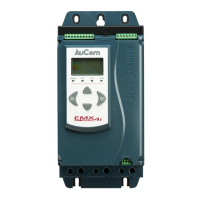
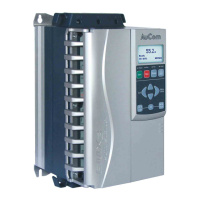
Outlines the key features and capabilities of the EMX4e soft starter.
Explains the structure and meaning of the EMX4e model designation.
Guides users on selecting the correct soft starter model for their application.
Provides tables of current ratings for various models and conditions.
Lists the physical dimensions and weight of different EMX4e models.
Details mounting and spacing requirements for installing the soft starter.
Describes available expansion cards and other accessories for the EMX4e.
Recommends installing a main contactor or circuit breaker for protection.
Explains how to control power factor correction using the soft starter.
Discusses fuses and coordination for short circuit protection.
Lists recommended fuses for IEC Type 1 and Type 2 coordination.
Provides fuse and breaker recommendations for UL applications.
Details semiconductor fuse selection for Type 2 coordination.
Lists electrical, environmental, and performance specifications for the EMX4e.
Provides guidance on the proper disposal of electrical equipment.
Explains how to select the method for starting and stopping the EMX4e.
Provides a step-by-step guide for initial application configuration.
Details the available input terminals and their functions, including thermistor.
Describes the function and connection of the analog and relay outputs.
Specifies the control voltage requirements and terminal connections.
Details the power input and output terminal specifications and connections.
Shows a wiring diagram for a typical installation with a main contactor.
Guides users through configuring common applications using the Quick Setup menu.
Allows selection of the command source via Setup Tools or parameter.
Enables manual starting and stopping of the starter via the local keypad.
Simulates motor operation to confirm correct installation and wiring.
Offers options to reset, load, or save starter parameter settings.
Explains how to save and load parameter settings and event logs via USB.
Details how to configure IP, Gateway, and Subnet Mask for network communication.
Displays the current status of digital inputs and outputs.
Shows the status of the thermistor input and analog output.
Displays product name, serial number, and model number.
Reports the version of different software components within the starter.
Describes how to disable the thermistor input if no longer needed.
Explains how to reset the motor's thermal model for accurate protection.
Stores details of recent trips, warnings, and operations.
Generates a QR code for accessing starter information via smartphone.
Records statistics like hours run and number of starts.
Explains the functions of the local and remote keypads and their buttons.
Details the use and connection of an optional remote keypad.
Describes how to adjust the display backlight brightness.
Explains the meaning of the status LEDs on the starter.
Covers the information shown on the starter's display screens.
Defines how to send start, stop, and reset commands to the EMX4e.
Allows an input to override the primary command source.
Enables running the motor while ignoring trip conditions for safety.
Configures external trip inputs for stopping the motor.
Offers suggested start/stop parameters for common applications.
Explains different soft starting techniques like Constant Current and Timed Voltage Ramp.
Describes Coast to Stop and Timed Voltage Ramp Soft Stop methods.
Accesses the primary menu for viewing and modifying parameters.
Details the procedure for changing parameter settings using the keypad.
Prevents unauthorized changes to parameter settings by enabling a lock.
Provides a comprehensive list of all programmable parameters and their default settings.
Configures essential motor parameters like Full Load Current and Service Factor.
Sets parameters for different soft start and stop modes and timing.
Defines trip points and delays for various motor protection features.
Specifies how the starter responds to detected protection events.
Configures the function, trip behavior, and naming of digital inputs.
Sets the function, delays, and flags for the relay outputs.
Configures the analog output signal and scaling for monitoring.
Customizes display language, temperature scale, and graph settings.
Configures network settings like Modbus, DeviceNet, and IP addresses.
Adjusts advanced control algorithm behavior and starter settings.
Details parameters specific to installed smart cards.
Explains how the starter reacts to protection conditions and faults.
Lists common display messages, their causes, and suggested solutions.
Describes situations where the starter behaves unexpectedly without tripping.
 General
| Brand | AuCom |
|---|---|
| Model | EMXAe |
| Category | Controller |
| Language | English |


 To Next Page