Avant e5
27
.
Tipping load
Tipping load is the load at which the rear tyres lose
contact with the ground and the loader starts to tip
forward. A tipping load chart is shown on the next
page. The tipping load depends on many factors,
and the chart shows the influence of the position of
the loader boom.
The lifting capacity and the stability of the loader are
at the best, when:
the loader frame is kept straight
the centre of gravity of the load is as close to the
loader as possible
counterweights are fitted to the loader
swinging of the load is prevented and all controls
are used in a calm and careful manner
There are many influencing factors that affect the
stability of the loader in practise. Use the load chart
and ROC table to estimate the load handling
capacity of the loader. Observe the instructions and
information given in this manual.
See also page 50 for more information about safe
handling of heavy loads and page 51 for a list of
typical factors that influence the stability of the
loader.
.
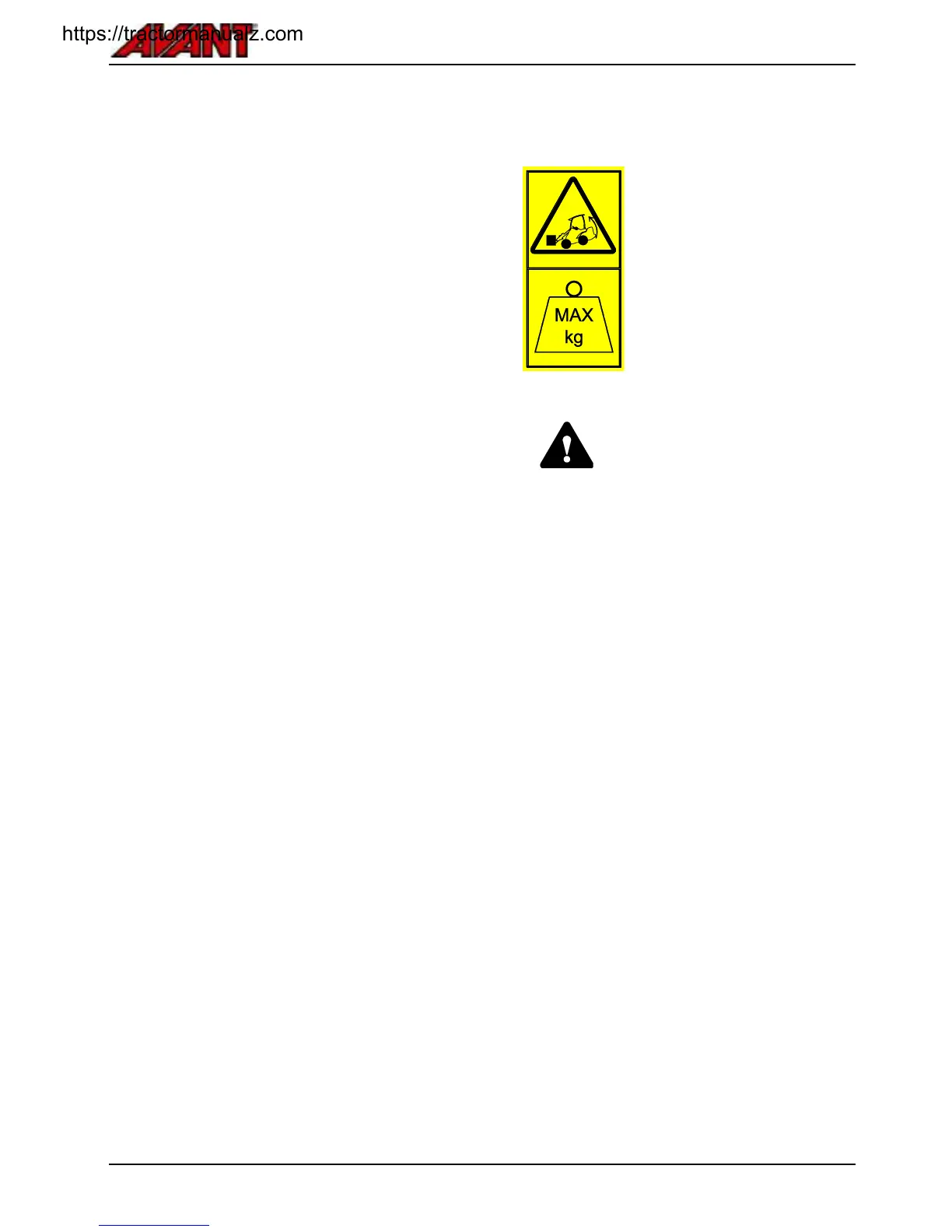
Risk of tipping over - Follow
safety instructions. The lifting
capacity of the loader is limited by
the possibility of tipping around the
front axle.
The operator must pay attention to
safe operating conditions
whenever handling loads.
All counterweights affect
stability - Also the driver. Always
keep in mind: If the driver leaves
the machine, tipping and max.
loads are reduced respectively.
The indicated tipping loads and the ROC table are valid, when:
The ground is firm and level
Loader is stationary or driven max 2 km/h, with smooth and slow control movements
Driver 75 kg is seated on the driver’s seat
Load is distributed evenly on pallet forks, with the load centre of gravity at 400 mm from the vertical part of
pallet fork arms. The weight of the fork attachment is taken into account in the indicated load values
https://tractormanualz.com



 To Next Page