Syscompact 2000 M pro Cable fault pre-location
822-175-2 57 / 98
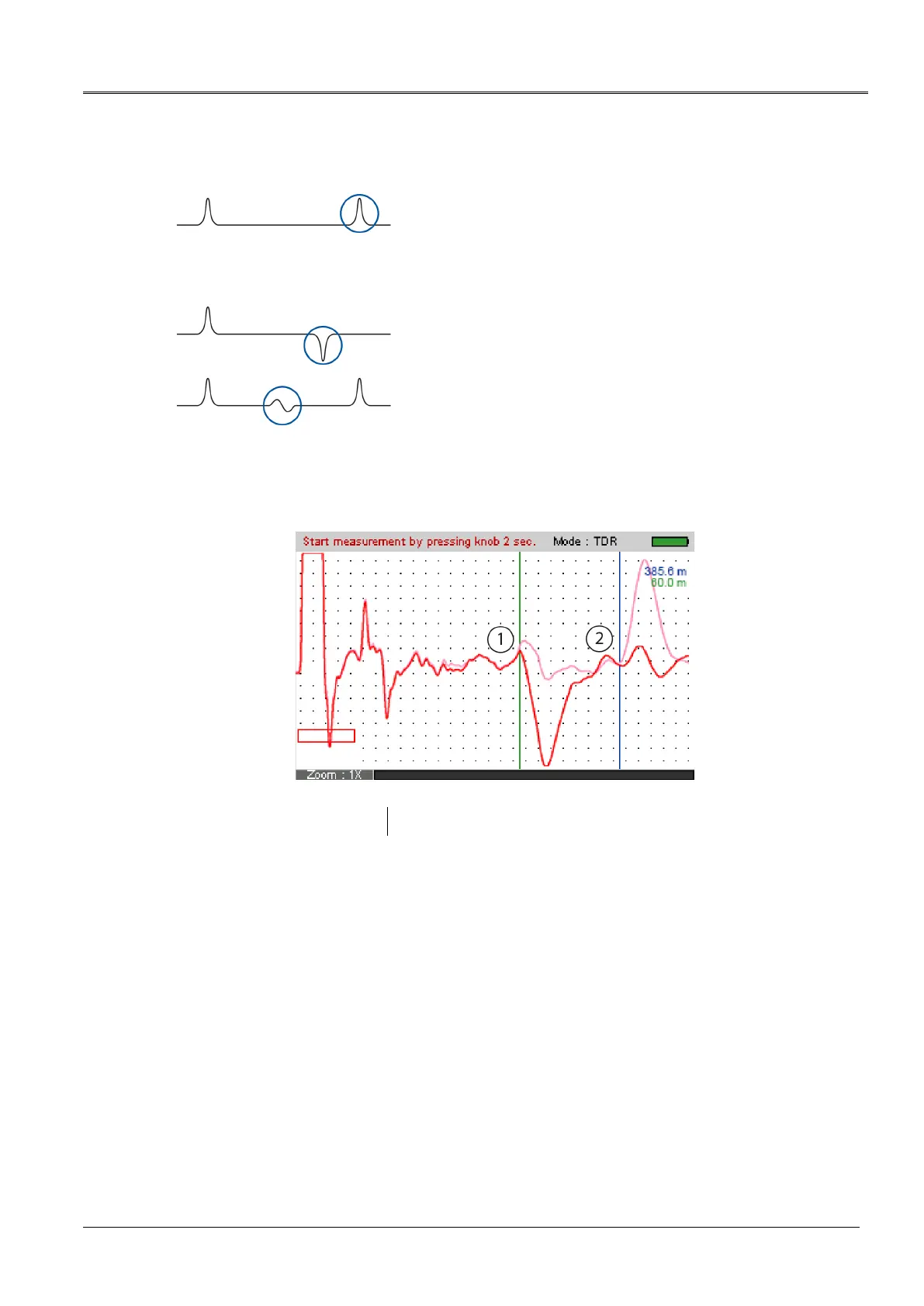
Typical traces:
Open cable end
The reflection is a positively increasing pulse. There is no pulse from the
far end.
If the positive reflection is displayed before the actual cable end, there
could be a cable break or the cable length could be incorrect.
Short-circuit or low-resistive fault
The reflection is a negatively decreasing pulse. There is no pulse from the
far end.
Changes in cable type, joints (impedance changes)
The amplitude of the reflecting pulse depends on the extent of the
impedance change. The joints generate s-shaped reflections.
Procedure during evaluation
1 Fault position (negative reflection)
2 Cable end (positive reflection)
If possible, compare the traces of a healthy and a faulty phase. The differences in the traces
clearly indicate possible fault positions.
1. Perform a TDR measurement on a healthy phase.
2. Press the FUNCTION key.
3. Use the rotary knob to select the Set REF button and press the rotary knob.
The trace of the healthy phase is saved temporarily.
4. Perform a TDR measurement with the same settings on a faulty phase.
5. Press the COMPARE key.
6. Use the rotary knob to select the Insert REF button and press the rotary knob.
The temporarily saved trace of the healthy phase is inserted in the reflection image.


 To Next Page