17 BOW THRUSTER BT160Kgf
ENG
INTRODUCTION
The installation quality is detriment for the efficiency and reliability of the bow thruster. Nearly all the problems encountered result f rom
errors or improper installations. Therefore is highly suggested to follow and check, during the installation, all the points present in the
installation manual.
Ensure the boat owner hav e a manual.
WARNING !
Ensure to checked and have all the safety requirement standards for the use of Bow thruster.
The bow thruster should not be operated close to swimmers because of the large amount of water pull ed during
the operation.
Professional competent personnel should effect the tunnel installation or modifications.
We recommend having the bow thruster installed by qualified personnel. An incorrect installation could lead the boat
and its personnel in danger.
1 TECHNICAL CHARACTERISTICS
Bow thruster
Type BT160Kgf
Weight 52 Kg
Electric Motor
Type Motore in c.c. reversibile
Supply 24 Vdc
Current 433 A
Nominal Power 8 Kw / 10.7 Hp
Revs / M in. 3000 rpm
Duration of operation S2 – 3min
Protection IP20
Conform normative CE (89/336/EEC/EMC-EN60945)
Transmission
Gears Spiral conical teeth
Transmission ratio 1,9 : 1
Lubrification Oil bath type EP90 litre 0.56 ca.
Propeller
Diameter 246 [mm]
Number of blades 3
Profile Symmetric
Nominal Propulsion 1600 [N] / 160 [Kgf] / 353 [lab]
Material Poliacetato (Derlin®)
Batteries
Minimum battery capacity recommended (Cold Starting
capacity according to DIN standards)
600CCA DIN (24Vdc)
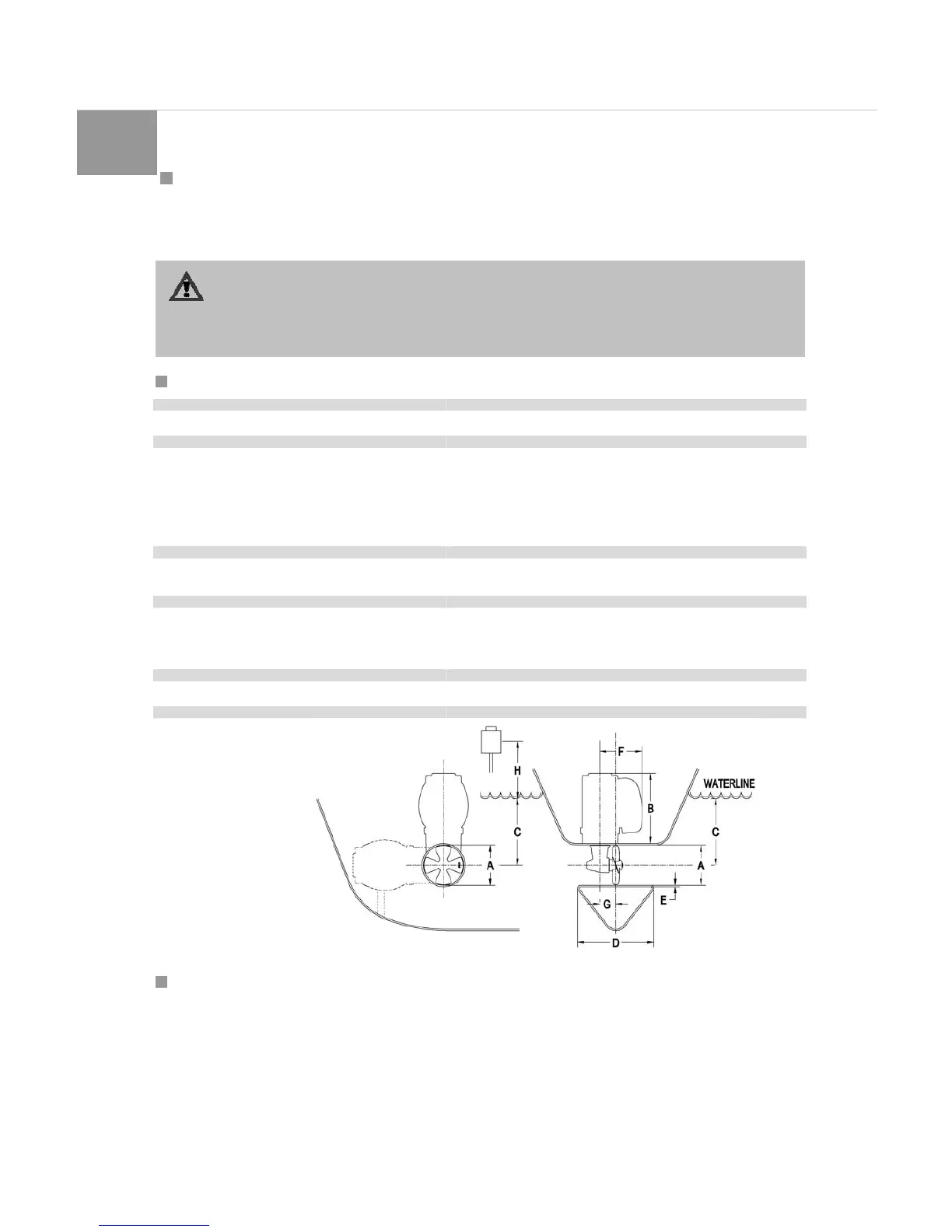
Principal dimensions and size
A 250
B
475
C
250 min
D
500÷1000
E
7
F
160
G
105
H 500 min
Dimensions in mm
2 INSTALLATION RECCOMENDATIONS
Its important to install along the positive supply line a main
switch and a fuse in order to isolate completely the supply of
the bow thruster and protect the bow thruster from any
overcharging and protect the line from short circuits. The
position on board should be easily accessible and known by
the person in charge on the boat. The supply line of t he bow
thruster has to be disconnected when no one is on board.
The electric bow thruster utilise high power motor, and is
therefore necessary to utilise batteries with sufficient capacity
and cables of sufficient diameter to prev ent from problems of
power loss and overheating.
The location where the bow thruster’s electric motor and the
batteries’ are located should be dry and well ventilated.
The batteries s hould not be connected until the bow thruster
installation is complete.


 To Next Page