20
ENG
POLIESTER TUNNEL
Resin The type of r esin used for polyester tunnels is a polyester resin with an isopholic acid base (Norpol PI 2857).
Treatment
The external part of the t unnel must be clean. Utilizing a grinding disc, remove all the superior layers till t he
fibreglass.
Important
Treat the end of the tunnel with resin, after you have marked and cut to length the tunnel required. By this you
ensure that humidity will penetrate in the material.
Lamination
As a first coat apply a layer of resin. Apply a mesh of glass fibre and coat with resin; repeat this operation until
a sufficient number of layers have been applied.
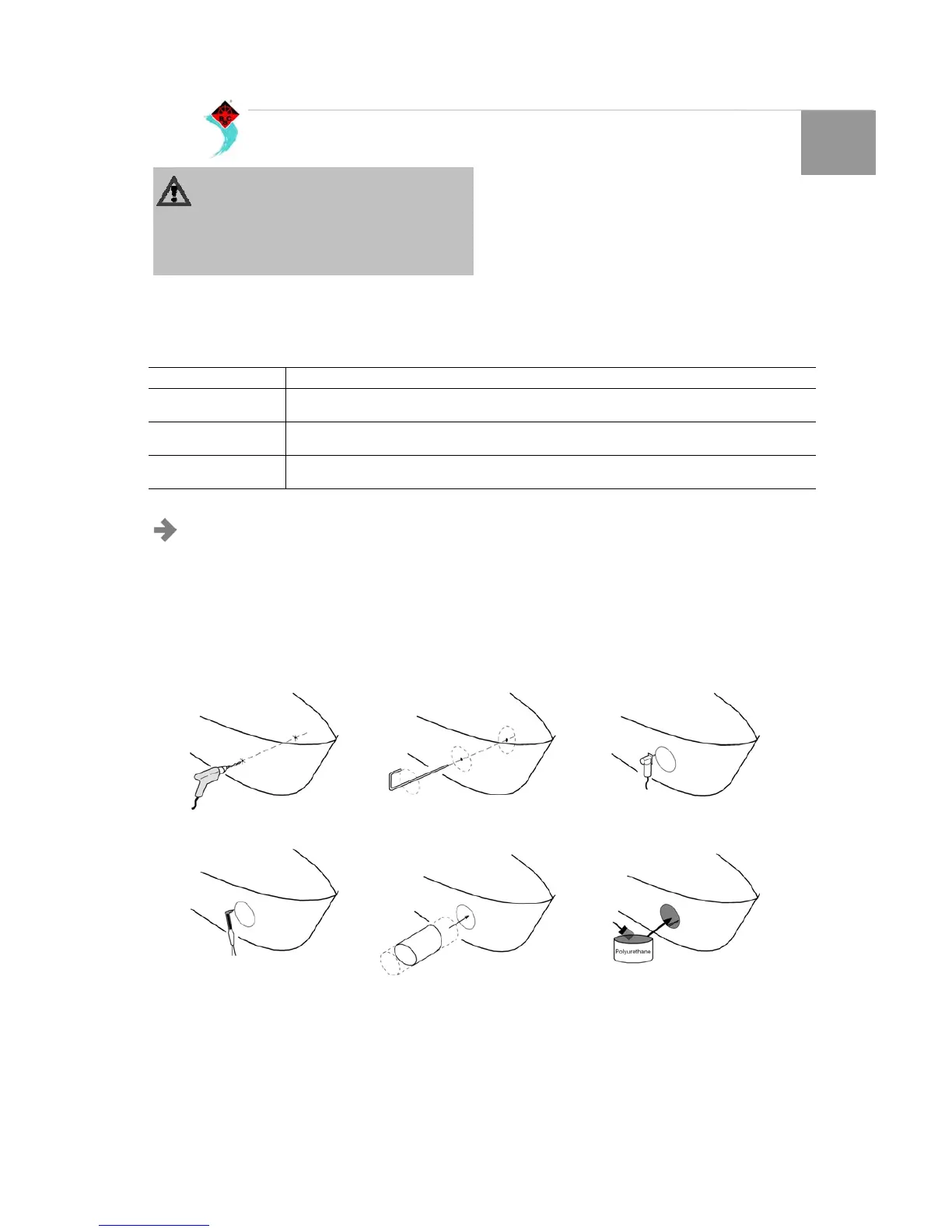
A polyester tunnel must be finished as follows: (Fig. 19):
• Sand the hardened fibreglass mesh.
•
Apply a layer of resin.
• Treat the ends of the tunnel, which come in contact with
the water example with eposidice lacquer or with a two
pack polyurethane pain.
• Apply consecutively an antifouling paint.
ATTENTION!
We recommend that a professional person do the
tunnel installation. These instructions are only
general, and do not explain in details the fibreglass
works. Problems resulting f rom incorrect installation
are to be followed by the installers.
• Located the position on the boat according to the information
submitted in the previous paragraphs, drill two holes in the hull
to locate the centre of the tunnel (Fig. 15).
•
Pass the instrument to draw the profile of the tunnel (not
supplied) though the holes drilled and draw the external
diameter of the tunnel on the hull (Fig. 16).
• Once drawn on the hull, cut the two opening by means of the
appropriate tools. (Fig. 17a-17b).
• Insert the tunnel (Fig. 18).
Fig. 19Fig. 18Fig. 17b
Fig. 17aFig. 16Fig. 15


 To Next Page