BD FACSCelesta Flow Cytometer User’s Guide102
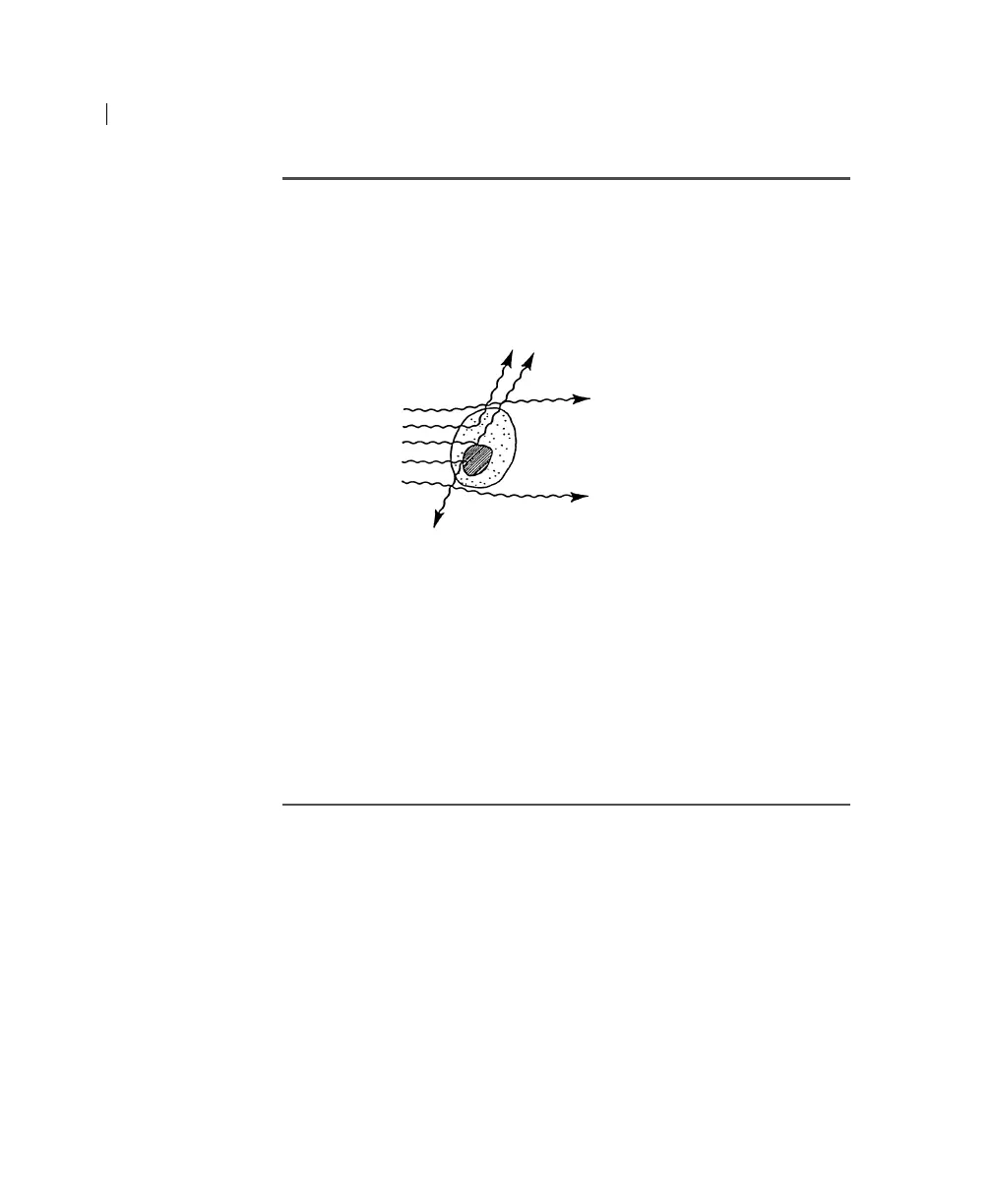
Light scatter When a cell or particle passes through a focused laser beam, laser
light is scattered in all directions. Light that scatters axial to the
laser beam is called forward scatter (FSC) and light that scatters
perpendicular to the laser beam is called side scatter (SSC).
FSC and SSC are related to certain physical properties of cells.
•FSC. Indicates relative differences in the size of the cells or
particles. Larger cells scatter more light and therefore they are
higher in FSC.
• SSC. Indicates relative differences in the internal complexity or
granularity of the cells or particles. More granular cells deflect
more light than less granular cells, and therefore are higher in
SSC.
Fluorescence When cells or particles stained with fluorochrome-conjugated
antibodies or other dyes pass through a laser beam, the dyes can
absorb photons (energy) and be promoted to an excited electronic
state. In returning to their ground state, the dyes release energy,
most of which is emitted as light. This light emission is known as
fluorescence.
Fluorescence is always a longer wavelength (lower-energy photon)
than the excitation wavelength. The difference between the
excitation wavelength and the emission wavelength is known as
the Stokes shift. Some fluorescent compounds such as PerCP
exhibit a large Stokes shift, absorbing blue light (488
nm) and
emitting red light (675
nm), while other fluorochromes such as
Light source
Side scatter (SSC)
Forward scatter (FSC)



 To Next Page