BD FACSCelesta Flow Cytometer User’s Guide104
Optical filter theory Optical filters modify the spectral distribution of light scatter and
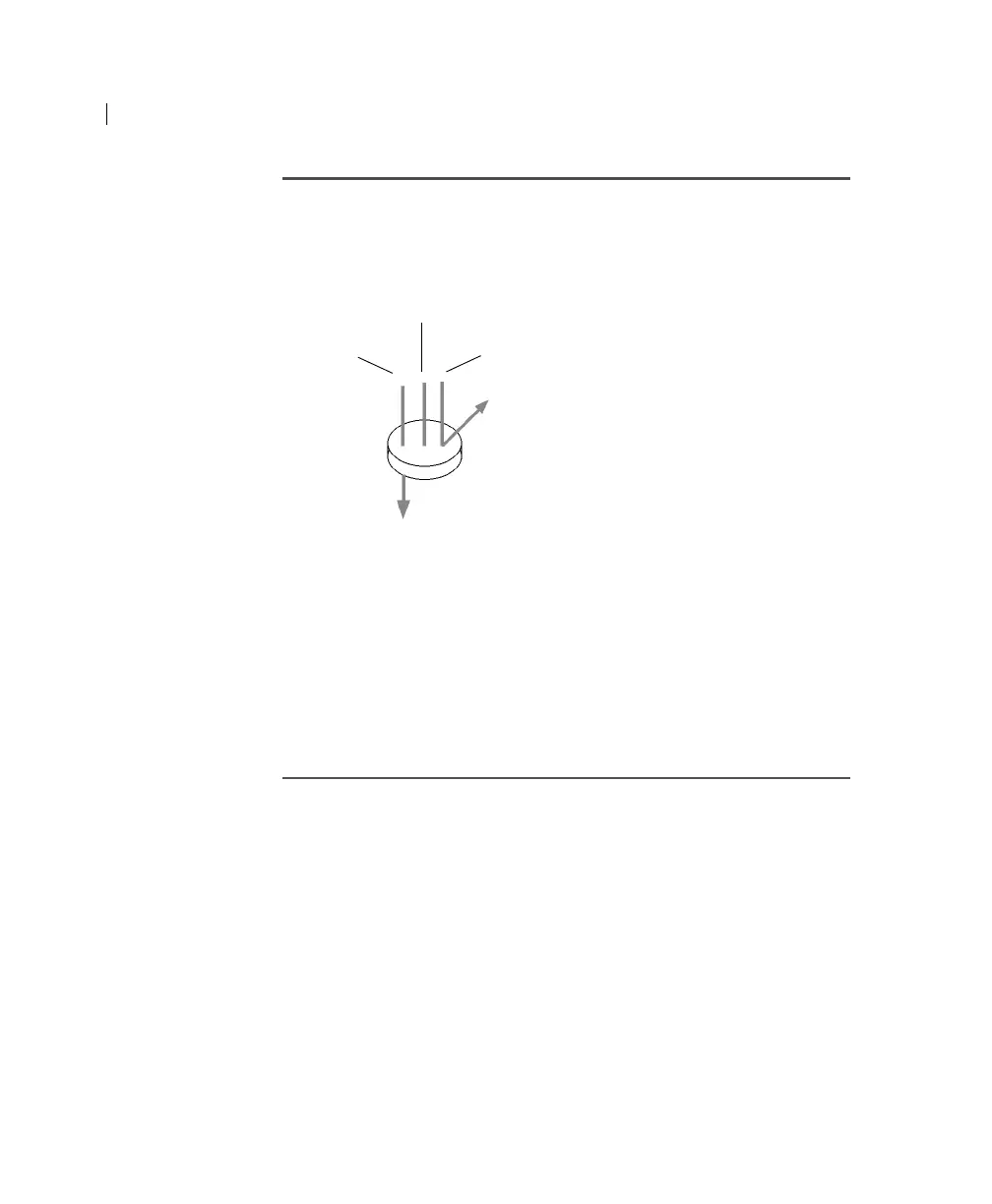
fluorescence directed to the detectors. When photons encounter an
optical filter, they are either transmitted, absorbed, or reflected.
Even though an optical filter is rated at its 50% transmission point,
the filter passes (lets through) a minimal amount of light outside of
this indicated rating.
The slope of an optical filter transmission curve indicates filter
performance. A relatively steep slope indicates a high-performance,
high-quality optical filter that provides deep attenuation of out-of-
band wavelengths. A less steep slope indicates that more light
outside the rated bandwidth is being transmitted.
Types of optical
filters
There are four types of filters.
• Longpass (LP) filters. Transmit wavelengths at or longer than
the specified value.
• Shortpass (SP) filters. Transmit wavelengths at or shorter than
the specified value. This type of filter is not recommended.
• Bandpass (BP) filters. Pass a narrow spectral band of light by
combining the characteristics of shortpass filters, longpass
filters, and absorbing layers.
• Notch filters. Pass all frequencies except those in a stop band
centered on a center frequency. They are the opposite of
bandpass filters.
Photons
absorbed
Photons
reflected
Photons
transmitted


 To Next Page