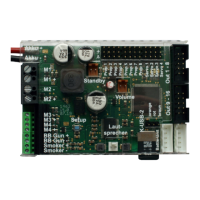
GB Sound speed controller SFR-1
06.02.2019 BEIER-Electronic 35
Digital switches at sum signal SUMD3
With the sum signal "SUMD3" some remote controls (for example Graupner mz-16,
mz-32) can also transmit up to 64 digital switches. Each digital switch can be
assigned with a function oft the SFR-1 (see page 63). Thus, these digital switches
are ideal for controlling the various functions of the SFR-1.
Each digital switch can be set on the transmitter, in the "On/Off", "Pulse" and "Flash"
modes.
For the following functions of the SFR-1 the mode "Pulse" must be selected:
• Light switch + and Lightswitch -
• All WAV-Player functions (play, pause, track rev / fwd, random)
• Indicator left and indicator right
• All additional sounds, in mode „once“
The default 0.5 s can be retained in the transmitter as pulse time. The pulse time can
also be reduced to 0.1 s, which speeds up the transmission a bit.
For all other functions of the SFR-1 the mode "On/Off" should be selected.
Switching outputs
The SFR has 16 outputs, which can be used to drive electrical consumer units such
as lamps, light-emitting diodes, relays, smoke generators etc. Different switching
functions and output types can be attached to the 16 outputs by using the Sound-
Teacher (see page 69).
The SFR-1 is always switching the negative pole to each output and thus to the
connected load (e.g. LED, lamp, relay). The loads plus pole is connected directly to
the supply voltage, or to the black and white cables of the output blocks (collected
plus pole).
The intensity (PWM-control) of each output can be configured with the Sound-
Teacher by steps of 2%, between 2% and 100%.
If relays or other inductive loads (e.g. motors) should be connected to the switching
outputs, free-wheeling diodes must (e.g. 1N4007) be used.
Following output types are possible:
• Output static on
• Output flashing
• Output as pulse
• Output flickering (sound dependend)
• Daytime running light
• Parking light
• Low beam headlight


 To Next Page