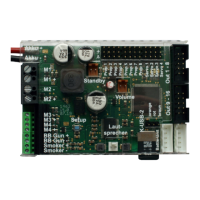
GB Sound speed controller SFR-1
06.02.2019 BEIER-Electronic 57
Bell armature motor:
With a bell armature motor the PWM frequency is increased to motor gently 40 kHz.
Channel reversion
In case the motor is running in the opposite direction (backwards instead of forwards)
it can be inverted here.
All proportional channels of steering channel (X2), steering servo (X5/3) can be
reversed. Right and left are turned with this option.
Load regulation
With activated load regulation one of the different regulation intensities (light,
medium and heavy) can be set here.
Inertia
To simulate a very heavy vehicle the option mass inertia can be activated here.
Acceleration and decelaration are slowed down for a realistic driving behaviour. Keep
in mind: the vehicle also has a longer stopping distance!
With a proportional channel or a nautic/multiswitch and the function “ Intertia light,
medium, heavy and off“ different intensities of inertia can be set while driving.
Inertia of steering
For a realistic steering behaviour a intertia can be activated. For this effect the
steering servo must be connected to proportional channel X4/2.
There is also an option for a speed dependent steering inertia:
• While parking: high inertia
• Slow driving: low inertia
• Medium drive: medium inertia
• Fast drive: high inertia
With the parameters „Steering angle limit at stationary“ and „Steering angle limit at
top speed“ the steering angle can be optimized. Values between 30 % and 120 %
can be set. The smaller the value, the smaller the steering angle. Values higher than
100 % make the steering angle larger. It is important to check first, if the steering
servo is suitable for large angles.
When driving between stationary and full throttle the SFR-1 calculates the
corresponding steering angle within the defined max/min values.
If no limits are manually set, the standard values are 100 %.
The application of steering angle limitation is quite useful, in case there is no option
to limit the angle directly at the radio.
Furthermore this function enables to use a different range of steering for
manoeuvring and for normal (fast) driving. During manoeuvring the full range is
useful whereas at high speed a smaller steering range enables a more sensitive
steering.


 To Next Page