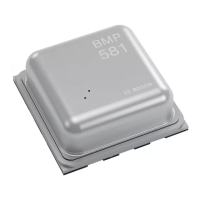
The Bosch Sensortec BMP581 is an absolute barometric pressure sensor designed for a wide range of applications due to its small dimensions, low power consumption, and high-end performance.
Function Description
The BMP581 measures absolute barometric pressure and temperature. It features on-chip linearization and temperature compensation to provide true absolute pressure and temperature readings. The sensor can operate in various power modes, including STANDBY, DEEP STANDBY, FORCED, NORMAL, and CONTINUOUS modes, allowing for flexible power management based on application needs. It includes programmable low-pass filtering, an on-chip FIFO buffer for up to 32 pressure samples, and programmable interrupts, including pressure-changed detection. The device also has 6 bytes of user-programmable non-volatile memory.
Important Technical Specifications
Pressure Performance:
- Operating Range: 30 to 125 kPa
- Absolute Pressure Accuracy: ± 0.5 hPa (max)
- Relative Pressure Accuracy: 0.06 hPa per 10 kPa step
- Offset Temperature Coefficient: ± 0.5 Pa/K (for 300-1100 hPa, -5 to 65 °C, 10 K steps)
- Pressure Data Resolution: 1/64 Pa
- Pressure Noise:
- 0.78 PaRMS (lowest power OSR setting)
- 0.21 PaRMS (high resolution OSR setting)
- 0.08 PaRMS (highest resolution OSR setting)
- Long Term Drift: ± 10 Pa (during 1 year)
- Short Term Drift: ± 1.5 Pa (during 24 h at constant pressure and temperature)
- Solder Drift: ± 30 Pa (5x reflow soldering after storage in standard conditions)
Temperature Performance:
- Operating Range: -40 to 85 °C
- Absolute Accuracy: ± 0.5 K (for -5 to 55 °C), ± 1.5 K (for -40 to 85 °C)
- Relative Accuracy: ± 0.5 K (for -40 to 85 °C, 20 K steps)
- Temperature Data Resolution: 1/65536 °C
Electrical Characteristics:
- Power Supply Voltage (VDD): 1.71 V to 3.6 V (typical 1.8/3.3 V)
- Power Supply Voltage I/Os (VDDIO): 1.08 V to 3.6 V (typical 1.2/1.8/3.3 V)
- Supply Ramp Time: 0.01 ms (min) to 10 ms (max)
- Power-up Time: 2 ms (time to first communication)
- Current Consumption:
- Deep Standby: 0.4 µA (25 °C, VDDIO=VDD=1.8 V) to 3.5 µA (55 °C, VDDIO=VDD=1.8 V)
- Standby: 0.5 µA (25 °C, VDDIO=VDD=1.8 V) to 5.5 µA (55 °C, VDDIO=VDD=1.8 V)
- Low Power Mode (1 Hz ODR): 1.3 µA
- High Resolution Mode (30 Hz ODR): 75 µA
- Digital Interface: Primary digital interface with 12 MHz slave SPI (4-wire, 3-wire), 12.5 MHz I3C, and up to 1 MHz I²C (Fm+).
- Package: Compact 10-pin metal-lid LGA package with a footprint of 2.0 x 2.0 mm² and max 0.8 mm package height.
Usage Features
Power Modes:
- STANDBY mode: No measurements, minimal power consumption. All registers are accessible. Pressure and temperature data registers retain last measurement values. FIFO content is maintained if enabled.
- DEEP STANDBY mode: Even lower power consumption than STANDBY, entered under specific conditions (ODR_CONFIG.deep_dis = 0, ODR_CONFIG.odr < 5Hz, FIFO_SEL.fifo_frame_sel = DIS, DSP_IIR.set_iir_t = BYPASS, DSP_IIR.set_iir_p = BYPASS).
- FORCED mode: Performs a single measurement and then returns to sleep mode. Recommended for low sampling rates or host-based synchronization, and ODRs higher than 240 Hz.
- NORMAL mode: Continuous measurements at a configurable output data rate (ODR).
- CONTINUOUS mode: Continuous measurements at a configurable output data rate (ODR).
Measurement Configuration:
- Oversampling Ratio (OSR): Individually configurable for pressure and temperature to reduce noise at the cost of higher power consumption.
- IIR Filter: Dedicated built-in IIR filter to reduce noise from ambient disturbances (e.g., opening doors, wind). Can be independently programmed for temperature and pressure.
- Data Registers: Pressure and temperature data are available in dedicated registers (PRESS_DATA_MSB/LSB/XLSB, TEMP_DATA_MSB/LSB/XLSB). Burst reads are recommended for data consistency.
- FIFO Buffer: Stores pressure and temperature data in frames. Supports 16 frames for both P&T, or 32 frames for P or T only. Configurable for streaming mode (oldest data deleted on overflow) or stop-on-full mode (new data not written on overflow). FIFO decimation factor can be adjusted.
Interrupts:
- Programmable Interrupts: Signals events to the host processor.
- Interrupt Pin (INT): Configurable for pulsed or latched mode, active high/low polarity, and open-drain/push-pull output.
- Interrupt Sources: FIFO full, FIFO threshold, data ready, and out-of-range pressure.
- Out-of-Range (OOR) Interrupt: Triggers when pressure is outside a defined range for a specified number of samples, reducing the need for continuous host monitoring.
- Power-On Reset (POR) Interrupt: Signals when the device is ready after power-up.
Digital Interface:
- Protocol Selection: Automatic selection between I²C, I3C, and SPI based on CSB pin behavior after power-up.
- I²C Mode: Supports normal, fast, and fast mode plus (up to 1 MHz). Slave addresses are 7'h46 (SDO=1'b0) and 7'h47 (SDO=1'b1).
- I3C Mode: Supports I3C protocol 1.0 SDR mode (up to 12.5 MHz), including I2C compatibility, In-Band Interrupts (IBI), and timing control.
- SPI Mode: Supports 3-wire and 4-wire configurations.
Maintenance Features
NVM Programmability:
- User Range: Contains a user-programmable non-volatile memory range (addresses 0x20-0x22) for end-of-line trim at OEM or ODM sites.
- NVM Read/Write Procedure: Specific procedures are outlined for reading from and writing to the NVM user range, including waiting for
STATUS.nvm_rdy and checking for errors.
- NVM CRC Check: Integrity of the NVM can be checked using a CRC-16 calculation (CCITT-16 polynomial: x16 + x12 + x5 + 1) to detect alterations or corruption.
- Soft Reset: The device can be reset by writing 0xB6 to the CMD register, which overwrites user configuration settings with default states.
Environmental Safety:
- RoHS Compliant: Meets the requirements of the EC restriction of hazardous substances directive (2015/863).
- Halogen-Free: The BMP581 is halogen-free.
Soldering and Storage:
- MSL 1 Classification: Classified as Moisture Sensitivity Level 1 according to IPC/JEDEC standards J-STD-020E and JSTD-033D.
- Storage: Devices should be stored at room temperature (20°C) to ensure good solderability.
- Reflow Soldering: Tested for Pb-free soldering according to J-STD-002E, supporting up to 3 reflow cycles. Minimum solder height of 25µm is recommended for mechanical decoupling.
- Offset Shift: Soldering can cause a reversible offset shift due to mechanical hysteresis. Multiple reflow cycles do not accumulate offset shifts.
- Avoidance: Avoid manual unsoldering at temperatures above 260°C or for more than 40 seconds, and prevent contact with liquids or small particles.

 Need help?
 General




 To Next Page