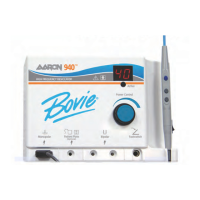
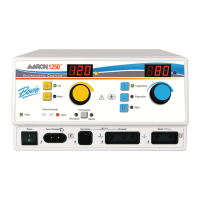
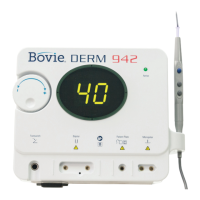
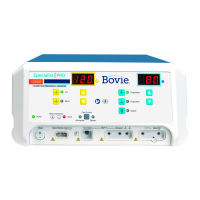
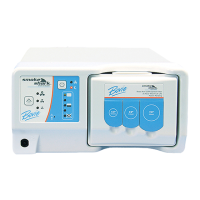
Bovie Medical Corporation1-4
WARNINGS:
• Position the patient return electrode to provide a direct current route between the surgical
site and the r
eturn electrode which avoids skin-to-skin contact areas.
• In addition, place patient return electrodes according to the manufacturer’s instructions.
Potential for alternate site burns increases if the return electrode is compromised.
Do not wrap the accessory cords or patient return electrode cords around metal objects. This
may induce currents that could lead to shocks, fires, or injury to the patient or surgical team.
CAUTIONS:
At no time should you touch the active electrode or bipolar forceps. A burn could result.
Do not stack equipment on top of the generator or place the generator on top of electrical equipment. These
configurations are unstable and/or do not allow adequate cooling.
Provide as much distance as possible between the electrosurgical generator and other electronic equipment (such as
monitors). An activated electrosurgical generator may cause interference with them.
Nonfunction of the generator may cause interruption of surgery. A backup generator should be available for use.
Do not turn the activation tone down to an inaudible level. The activation tone alerts the surgical team when an
accessory is active.
When using a smoke evacuator in conjunction with the electrosurgical generator, place the smoke evacuator a
distance from the generator and set the generator volume control at a level that ensures that the activation tones
can be heard.
The use of high frequency current can interfere with the function of other electromagnetic equipment.
When high frequency surgical equipment and physiological monitoring equipment are used simultaneously on the
same patient, place any monitoring electrodes as far as possible from the surgical electrodes. Monitoring systems
incorporating high frequency current limiting devices are recommended.
Do not use needles as monitoring electrodes during electrosurgical procedures. Inadvertent electrosurgical burns may
result.
To avoid the possibility of an electrosurgical burn to either the patient or the physicians, do not allow the patient to
come in contact with a grounded metal object during activation. When activating the unit, do not allow direct skin
contact between the patient and the physician.
Remove any loose fitting jewelry from the patient before activation.
Examine all accessories and connections to the electrosurgical generator before use. Ensure that the accessories
function as intended. Improper connection may result in arcs, sparks, accessory malfunction, or unintended surgical
effects.
When not using active accessories, place them in a holster or in a clean, dry, nonconductive,
and highly visible area not in contact with the patient. Inadvertent contact with the patient may result in burns.
Studies have shown that smoke generated during electrosurgical procedures can be potentially harmful to patients
and the surgical team. These studies recommend adequately ventilating the smoke by using a surgical smoke
evacuator or other means.
1
1. U.S. Department of Health and Human Services. National Institute for Occupational Safety
and Health (NIOSH). Control of Smoke from Laser / Electric Surgical Procedures. HAZARD
CONTROLS, Publication No. 96-128, September, 1996.
NOTICE:
Do not clean the generator with abrasive cleaning or disinfectant compounds, solvents, or other
materials that could scratch the panels or damage the generator.


 To Next Page