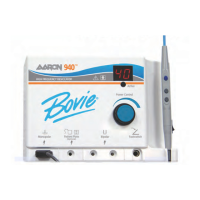
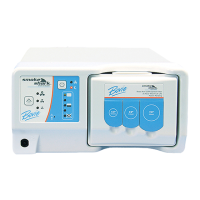
INSPECTING THE GENERATOR AND ACCESSORIES
Before each use of the Aaron 950™ Electrosurgical Generator, verify that the unit and all accessories are in good
working order:
• Inspect for damage to the Electrosurgical Generator and all its connections.
• Verify that the appropriate accessories and adapters are present.
• Inspect all cords and connectors for signs of wear, damage, and abrasion.
• Verify that no errors occur when you turn on the unit.
SETUP SAFETY
WARNINGS
Hazardous Electrical Output
- This equipment is for use only by trained, licensed physicians.
Electric Shock Hazard
- Connect the generator power cord to a properly grounded receptacle. Do not use power
plug adapters.
Connect the power cord to a properly polarized and grounded power source with the frequency and voltage charac-
teristics that match those listed on the back of the unit.
Fire Hazard
- Do not use extension cords.
Patient Safety
- Use the generator only if the self-test has been completed as described. Otherwise, inaccurate
power outputs may result.
The instrument receptacles on this generator are designed to accept only one instrument at a time. Do not attempt
to connect more than one instrument at a time into a given receptacle. Doing so will cause simultaneous activation
of the instruments.
Failure of the high frequency electrosurgical equipment could result in an unintended increase of output power.
Do not use electrosurgical equipment unless properly trained to use it in the specific procedure being undertaken.
Use by physicians without such training has resulted in serious, unintended patient injury, including bowel perfora-
tion and unintended, irreversible tissue necrosis.
For surgical procedures where the high frequency current could flow through parts of the body having a relatively
small cross-sectional area, the use of bipolar techniques may be desirable to avoid unwanted coagulation.
If the patient has an Implantable Cardioverter Defibrillator (ICD), contact the ICD manufacturer for instructions before
performing an electrosurgical procedure. Electrosurgery may cause multiple activation of ICDs.
In some circumstances, potential exists for alternate site burns at points of skin contact (e.g., between the arm and
the side of the body). This occurs when electrosurgical current seeks a path to the patient return electrode that
includes the skin-to-skin contact point. Current passing through small skin-to-skin contact points is concentrated and
may cause a burn. This is true for grounded, ground referenced, and isolated output generators.
To reduce the potential for alternate site burns, do one or more of the following:
• Avoid skin-to-skin contact points, such as fingers touching leg, when positioning the patient.
• Place 5 to 8 cm (2 to 3 in.) of dry gauze between contact points to ensure that contact does
not occur.
• Position the patient return electrode to provide a direct current route between the surgical
site and the return electrode which avoids skin-to-skin contact areas.
• In addition, place patient return electrodes according to the manufacturer’s instructions.
Potential for alternate site burns increases if the return electrode is compromised.
4-2 Bovie Medical Corporation


 To Next Page