ACTIVATION SAFETY
WARNINGS
Do not wrap the accessory cords or patient return electrode cords around metal objects.
This may induce currents that could lead to shocks, fires, or injury to the patient or surgical team.
Danger: Fire / Explosion Hazard
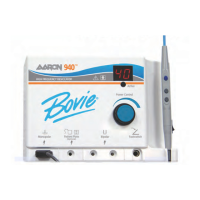
- Do not use the Aaron 950™ Electrosurgical Generator in the presence of
flammable anesthetics.
Fire / Explosion Hazard
- The following substances will contribute to increased fire and explosion hazards in
the operating room:
• Flammable substances (such as alcohol based skin prepping agents and tinctures)
• Naturally occurring flammable gases that may accumulate in body cavities such as the bowel
• Oxygen enriched atmospheres
• Oxidizing agents (such as nitrous oxide [N
2
O] atmospheres)
The sparking and heating associated with electrosurgery can provide an ignition source. Observe fire precautions at
all times. When using electrosurgery in the same room with any of these substances or gases, prevent their accumu-
lation or pooling under surgical drapes, or within the area where electrosurgery is performed.
Use the lowest output setting necessary to achieve the desired surgical effect. Use the active electrode only for the
minimum time necessary in order to lessen the possibility of unintended burn injury. Pediatric applications and/or
procedures performed on small anatomic structures may require reduced power settings. The higher the current flow,
and the longer the current is applied, the greater the possibility of unintended thermal damage to tissue, especially
during use on small structures.
Use electrosurgery with caution in the presence of internal or external devices such as pacemakers or pulse genera-
tors. Interference produced by the use of electrosurgical devices can cause devices such as pacemakers to enter an
asynchronous mode or can block the pacemaker effect entirely. Consult the device manufacturer or hospital
Cardiology Department for further information when use of electrosurgical appliances is planned for patients with
cardiac pacemakers or other implantable devices.
CAUTIONS
The use of high frequency current can interfere with the function of other electromagnetic equipment.
When high frequency surgical equipment and physiological monitoring equipment are used simultaneously on the
same patient, place any monitoring electrodes as far as possible from the surgical electrodes. Monitoring systems
incorporating high frequency current limiting devices are recommended.
Do not use needles as monitoring electrodes during electrosurgical procedures. Inadvertent electrosurgical burns may
result.
To avoid the possibility of an electrosurgical burn to either the patient or the physicians, do not allow the patient to
come in contact with a grounded metal object during activation. When activating the unit, do not allow direct skin
contact between the patient and the physician.
Remove any loose fitting jewelry from the patient before activation.
Examine all accessories and connections to the electrosurgical generator before use. Ensure that the accessories func-
tion as intended. Improper connection may result in arcs, sparks, accessory malfunction, or unintended surgical
effects.
When not using active accessories, place them in a holster or in a clean, dry, nonconductive, and highly visible area
not in contact with the patient. Inadvertent contact with the patient may result in burns.
Studies have shown that smoke generated during electrosurgical procedures can be potentially harmful to patients
and the surgical team. These studies recommend adequately ventilating the smoke by using a surgical smoke evacua-
tor or other means.
1
1. U.S. Department of Health and Human Services. National Institute for Occupational Safety and Health (NIOSH). Control
of Smoke from Laser / Electric Surgical Procedures. HAZARD CONTROLS, Publication No. 96-128, September, 1996.
4-6 Bovie Medical Corporation


 To Next Page