© 2022 Brivo Systems LLC. All rights reserved. PUB-Brivo ACS6100 Installation Manual
26
Brivo ACS6100 Installation Manual
contacts, and is driven in response to the presentation of valid credentials or the
programmable REX input.
c) Timing and other aspects of relay activation are programmed through the application.
3. If used for an alarm shunt, wire the AUX RELAY 1 terminal block. If not used for an alarm shunt, AUX RELAY 1
can be used for a variety of purposes.
NOTE: The fully programmable AUX RELAYs provide both NO (Normally Open) and NC (Normally Closed) contacts.
WARNING: Relay Amp Limit
THERE IS A 3A, 28VDC LIMIT ON THROUGH CURRENT FOR ALL RELAYS.
4. If used, wire the AUX INPUTS terminal block.
a) The IN1 and IN2 terminals are contact closure type inputs that share a COM terminal.
b) The terminals can be used for a variety of purposes, and are programmed through the
application.
5. Wire the Reader terminals to the last block of terminals in this door node. For Wiegand readers, refer to
Wiegand wiring instructions below. For OSDP Readers, refer to OSDP wiring instructions below.
NOTE: Wiegand readers use a 5V signaling level and Brivo hardware is compliant with 5V Wiegand readers. Any
reader that claims to be Wiegand but does not use 5V signaling is not compatible with Brivo hardware.
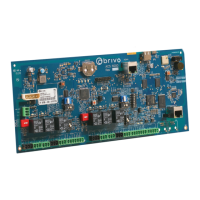
NOTE: To activate RS-485 functionality on the ACS6000 MAIN CONTROL BOARD for Door 1, put the RS-485/Wiegand
Door 1 switch in the RS-485 position. For Door 2, put the RS-485/Wiegand Door 2 switch into the RS-485 position.
To activate Wiegand functionality on the ACS6000 MAIN CONTROL BOARD for Door 1, put the RS-485/Wiegand Door
1 switch in the Wiegand position. For Door 2, put the RS-485/Wiegand Door 2 switch in the Wiegand position.
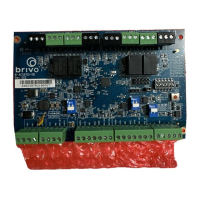
On B-ACS6100-DB door boards, the board automatically detects Wiegand versus OSDP readers.



 To Next Page