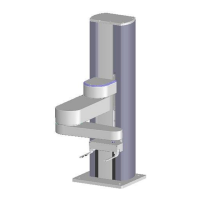
Atmospheric Single-Arm Robot Introduction
User’s Manual Atmospheric Single-Arm Robot Overview
Brooks Automation
Revision 1
1-5
Laser Scanner
The optional laser scanner is mounted on a robot arm to detect the presence of
wafers in cassettes. The Smart Controller (ESC) sends information back to the
host, indicating the presence, absence, or cross slotting in each wafer position.
The macros use this information to provide automatic transfer of wafers.
The robot orients the laser scanner toward the wafer cassette and moves the Z
axis to pass the laser vertically in front of each cassette slot. As the robot
moves, the scanner emits laser pulses towards each cassette slot. A photode-
tector receives any laser reflections from any wafers in the cassette.
The amplified signal from the photodetector is digitized and passed to a digital
signal processing (DSP) unit. The DSP internal memory stores the received sig-
nals and compares them with emitted laser pulses to generate an OUT signal.
Using the OUT signal, the controller captures the position at which the laser
hits a wafer. This is compared to the expected position of each slot to generate
a wafer map.
Robot Systems
The basic robotic system is comprised of an Smart Controller (ESC) and a robot.
Options include a pre-aligner, an optical scanner (or mapper), and a linear track. A
cassette tilter is an option in an Integrated Front-End System. Details on these compo-
nents are given in other Brooks Automation manuals; this section gives only a brief
overview.
Brooks Automation Smart Controller
The Brooks Automation Smart Controller (ESC) controls the functions of the
robot and other optional moving parts. The ESC provides servo control, power
supplies, an optional user interface, and diagnostics for robots, pre-aligners,
and track. The ESC and a host computer can communicate across an RS-232
line or the ESC can run stand-alone.
The ESC requires ac power. The ESC power cable and signal cables provide all
power and control signals to the robot:
• The power cable provides 24 VDC for vacuum valves and PWM power
for the servo motors.
• The signal cables provide the Galil motion controller board with
encoder signals from the servo motors and vacuum solenoid, brake, or
scanner commands to the robot, in addition to +5V and status indica-
tions.
For more information about the controller and printed circuit boards, refer to
the Smart Controller Hardware and Software User’s Manual.
Artisan Technology Group - Quality Instrumentation ... Guaranteed | (888) 88-SOURCE | www.artisantg.com



 To Next Page