Atmospheric Single-Arm Robot Installation
User’s Manual Teaching and Operating
Brooks Automation
Revision 1
3-21
Teaching and Operating
When you teach the robot system, you save the position, or coordinates, of the robot
axes. In addition, if your system is equipped with a laser scanner, you teach the scan-
ner positions and calibrate the laser scanner for this station.
Brooks Automation recommends training for anyone who programs, teaches, oper-
ates, maintains, or repairs a robot or robotic system. Brooks Automation offers end-
user training courses that provide proper safety training to people responsible for the
safe programming, operation, or maintenance of the robot.
Before issuing any macros that initiate automated robot actions, you must leave the
restricted envelope.
Robot Axis and Station Naming Conventions
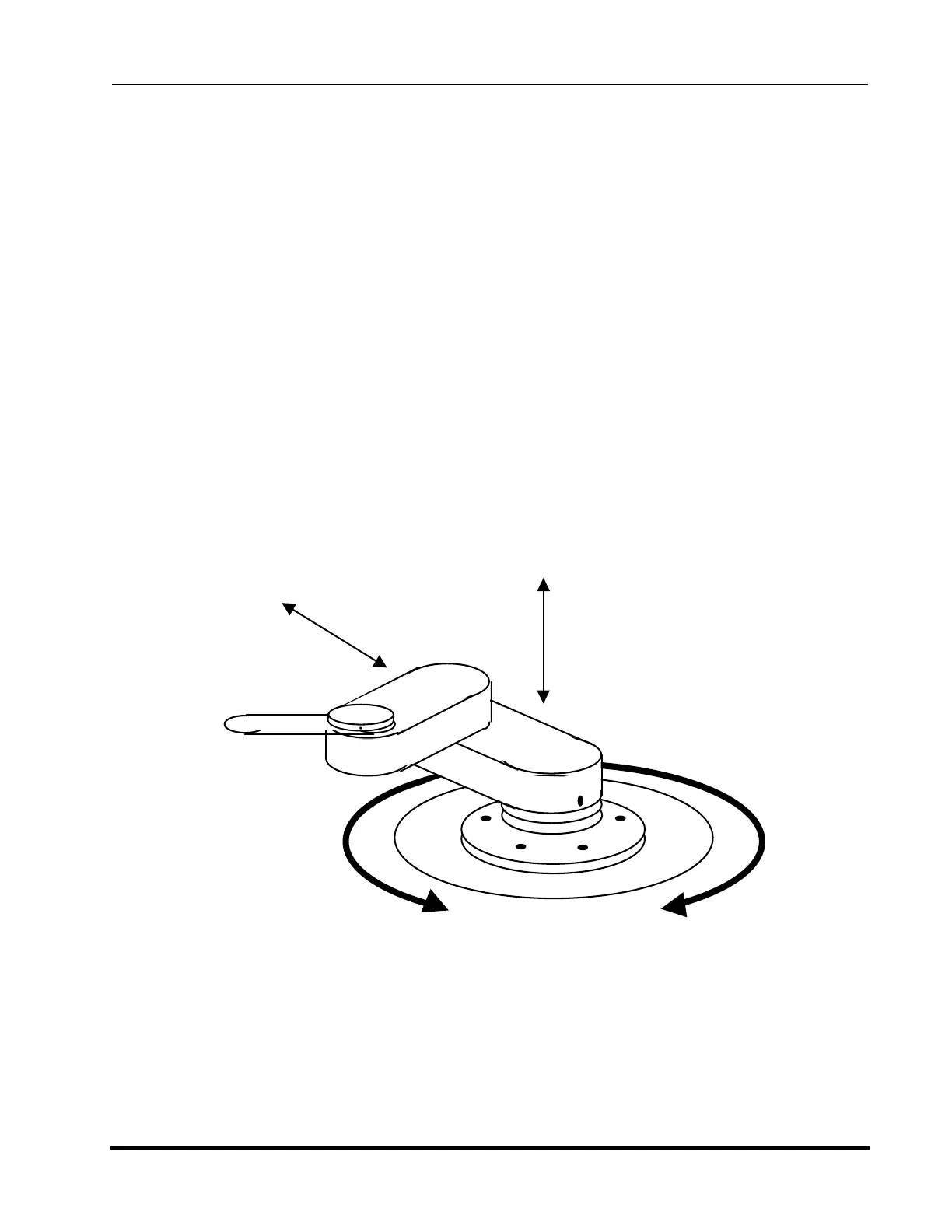
Brooks Automation robots use a three-axis system of motion.
The polar coordinate positions are T, R, and Z:
• T (Theta) axis controls rotation of the arm.
• R (Radial) axis controls the reaching and retracting of the arm.
• Z (vertical) axis controls vertical movement.
Theta or Rotation
Z or Vertical
R
a
d
i
u
s
o
r
R
ea
c
h
+
-
+
-
-+
Figure 3-6: Polar Coordinate Positions
Artisan Technology Group - Quality Instrumentation ... Guaranteed | (888) 88-SOURCE | www.artisantg.com



 To Next Page