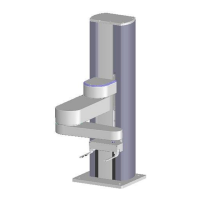
The PreciseFlex 100 Robot is a collaborative 4-axis robot designed for automating applications in Life Sciences, Medical Products, Semiconductor, and Electronics industries. It is available in XZ and XYZ configurations, with optional theta rotation and an electric gripper. The robot is designed as a tabletop unit and can carry a payload of up to 2 kg in the gripper.
Function Description:
The PreciseFlex 100 Robot is a versatile collaborative robot capable of precise motion and handling. It includes an embedded Guidance 1400A 4-axis motion controller, single-axis controllers, a 48VDC motor power supply, and a 24VDC logic power supply, all located within the X-axis. The robot can optionally include an electric gripper and its controller. For pneumatic gripping, the outer link can house a solenoid to control air. A light bar on the theta cover indicates operational status. The Z-axis features a fail-safe brake that can be manually released with a button on the Z-axis drive cover, provided 24VDC power is supplied.
The controller supports four programming modes: Digital IO (MotionBlocks), Graphical Programming (Guidance Motion), Embedded Language (GPL), and PC Control (TCP Command Server). The MotionBlocks, Guidance Motion, and GPL modes allow standalone operation after programming, while TCP Command Server mode requires a PC. A web-based operator interface is available for system configuration, execution control, and monitoring, accessible locally or remotely via Ethernet or a wireless tablet/computer.
An optional machine vision system, "PreciseVision," can run on a PC or an embedded PC within the robot. It supports Ethernet or USB cameras to obtain and process visual information for the networked motion controller.
Important Technical Specifications:
- Configurations: XZ, XZTheta, XZTheta+Gripper, XY, XYZ, XYZTheta, XYZTheta+Gripper.
- Payload: Up to 2 kg with gripper option; 3 kg for XZ or XYZ without theta and gripper.
- Axes:
- J1 (X) Axis: 635 mm or 1270 mm for XZ version; 500 mm or 1090 mm for XYZ version.
- J2 (Y) Axis: 350 mm.
- J3 (Z) Axis: 229 mm with XZ version or 260 mm with XYZ version.
- J4 (Theta) Axis: +/- 270 degrees.
- Gripper Travel: 76 to 136 mm.
- Spring Gripper Force: 2-23 Newtons closing, 2-10 Newtons opening, 7 Newtons power off.
- Resolution: 10 microns typical.
- Repeatability: +/- 0.100 mm overall in X, Y, and Z directions at 18-22°C.
- Maximum Acceleration: 10,000 mm/sec² with 1000gm payload.
- Maximum Speed: 1,500 mm/sec with 1000gm payload for XZ; 1,000 mm/sec for XYZ (typical).
- Motors: Brushless DC servo motors with absolute encoders on X, Y, Z, and Theta axes; no homing required.
- Controller: Guidance 1400D, Guidance 1100T Slave Amp, GIO optional IO Board.
- Power Supply: Dual input range 100-120 VAC +/- 10% and 200-240 VAC +/- 10%, 50/60 Hz.
- Power Consumption: Less than 200 Watts typical during normal operation; up to 400 Watts maximum.
- Weight: 20 kg for 635 mm travel version; 32 kg for 1270 mm travel version.
- Environmental Specifications:
- Ambient Temperature: 4°C to 40°C.
- Storage/Shipment Temperature: -25°C to +55°C.
- Humidity: 10 to 55%, non-condensing, non-corrosive.
- Altitude: Up to 3000 m.
- Pollution Degree: 2.
- IP Rating: 11.
- IK Impact Rating: IK08: 5 Joule.
- Interfaces:
- General Communications: RS-232 channel, 100Mb Ethernet.
- Digital I/O Channels: Four optically isolated 5-24V inputs, four optically isolated 24V outputs at 100mA on facilities panel. Optional 12 isolated inputs and 8 isolated outputs at back panel. Remote I/O also available.
- Pneumatic Lines: One air line, 75 PSI maximum, provided at outer link and routed internally to fittings on the Facilities Panel if selected.
Usage Features:
- Collaborative Design: TUV certified to exert forces within ISO/TS 15066 Standard guidelines for collaborative robots, allowing safe operation around personnel without safety shields in many cases. However, a risk assessment of the entire application (including end effectors, operation methods, objects handled, and workcell obstacles) is recommended.
- Quiet and Smooth Operation: Designed for low cost, extremely quiet, and smooth motion with excellent positioning repeatability.
- Safety Zones: Supports user-defined 3D safety zones (rectangular volumes, cylinders, spheres) to disable motor power or halt motion if the tool center point (TCP) violates specified boundaries. These include "keep out zones," "stay within zones," and "speed restrict zones" (Category 3 certified for redundancy).
- Emergency Stop (E-Stop): Integrator must provide an E-Stop switch. A soft E-Stop initiates rapid deceleration, while a hard E-Stop disables motor power. A parameter allows adjusting the delay between hard E-Stop signal assertion and motor power cut-off (nominally 0.5 seconds).
- Manual Control Mode: Robot speed is limited to 250 mm/sec for safety during manual control, used for teaching locations.
- Gripper Control: The servo gripper's squeeze force can be limited by modifying the motor's rated current. A more sophisticated asymmetric method allows limiting torque from the PID loop in positive and negative directions.
- Grip Test and Squeeze Check: The output torque to the gripper motor is available in Parameter 12304, allowing users to check if a plate is gripped by monitoring torque values. Spring compensation torque must be subtracted for accurate effective squeeze force.
- Absolute Encoders: Keep track of robot position even when AC power is disconnected, backed up by a battery in the robot's base.
- Software Updates: GPL (system software) and FPGA (firmware) can be upgraded in the field via the web interface.
- Recovery from Corrupted PAC Files: A procedure exists to recover from corrupted configuration files by loading factory default settings from flash memory.
Maintenance Features:
- Encoder Battery Replacement: The absolute encoder battery is monitored by the system, generating "Encoder Battery Low" or "Absolute Encoder Down" messages when voltage drops. Replacement involves disconnecting AC power, removing the X-axis rear cover, unplugging the old battery, and installing a new one. Recalibration may be necessary.
- Belt Tensioning: Simple belt tensioning procedures are provided for X-axis, Y-axis, and Z-axis belts using a Gates Sonic Belt Tension Meter.
- Motor and Belt Replacement: Procedures are outlined for replacing X-axis, Y-axis, Z-axis, and Theta axis motors and their timing belts. These are typically factory procedures but can be attempted by experienced service technicians.
- Gripper Harness Replacement: Detailed steps for replacing the gripper harness, including coiling it around the theta housing.
- Gripper Controller Replacement: Procedure for replacing the servo gripper controller, which does not require robot recalibration.
- GIO Board Installation: Instructions for installing the optional RS485 IO Module (GIO) board, including jumper settings and software address configuration.
- Preventive Maintenance Schedule:
- Every year: Check belt tension (re-tension if necessary) and check all joints in "free mode" for low bearing friction.
- Every three years: Replace all timing belts for high duty cycle applications.
- Troubleshooting: A comprehensive list of error messages and recommended actions for hardware failures, including encoder data errors, communication errors, motor duty cycle exceedance, amplifier issues, and physical problems like linear bearing streaks or mechanical noise.
- Recycling and Hazardous Materials: Brooks Automation complies with EU Directive 2002/96/EU (WEEE). End users are responsible for proper disposal, with technical support available for assistance.

 Need help?

 To Next Page
 General