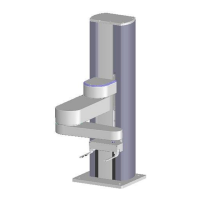
2. Introduction to the Hardware PreciseFlex 100 Robot
Machine Safety Part Number: 603988 Rev. A
In Computer Mode the robot can move quickly. The PP100 has been designed to be “hand-safe”
even in computer mode, and in some cases a risk assessment of the application may indicate that it
can be used without operator safety screens. However safety glasses should be worn at all times
when an operator is within the robots working volume. Refer to the EN ISO 10218-2011-1 and -2, for
Industrial Robots for information on recommended safe operating practices and enclosure design
for robots of various sizes and payloads.
Safety Zones
For all robot types, “Safety Zones” can be defined that disable motor power and halt the motion of
the robot if its tool center point (TCP) violates the requirements of a user defined 3D volume.
Types of Safety Zones
These 3D safety zones can be used to:
a. Approximately model the volume of stationary objects or personnel working areas to prevent the
robot from inadvertently entering this volume and causing a collision (“keep out zones”).
b. Reduce the normal working volume of the robot to prevent the robot from reaching beyond prescribed
boundaries and causing a collision (“stay within zones”).
c. Verify that the robot’s TCP speed (when in a specified volume) is below a specified limit so that the
robot can be safely decelerated and stopped before it might pin an operator’s hand to a hard surface
with too high a force (“speed restrict zones”).
As currently implemented, the “keep out zones” and “stay within zones” are provided as general
safety features, but they do not meet the stringent Category 3 safety standards that require fail safe
redundant logic. However, the “speed restrict zones” do provide the requisite redundancy and are in
the process of being Category 3 certified. The “keep out zones” and “stay within zones” are
collectively referred to as “uncertified zones” and the “speed restrict zones” are referred to as
“certified zones”.
The supported zone shapes are rectangular volumes, cylinders and spheres. To define a safety
zone, the type of safety zone must be specified along with its origin and dimensions.
28
Copyright © 2023 Brooks Automation, Inc.



 To Next Page