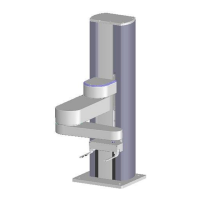
Installation Atmospheric Single-Arm Robot
Installation Procedure User’s Manual
Brooks Automation
3-6 Revision 1
Installation Procedure
The Atmospheric Single-Arm Robot is typically supplied in a standard configuration.
The information required to install the standard configuration of the product is pro-
vided in the following procedures:
• Mounting on page 3-6
• Facilities Connections on page 3-13
• Communication Connections on page 3-14
Tools and Materials
The following tools and materials are required during the installation of the Atmo-
spheric Single-Arm Robot.
• Standard hand tools
•Lifting device
Mounting
The robotic system is not intended for stand-alone use. The host tool provides power
and instructions to the robot system. Brooks Automation recommends that you locate
the operating controls outside the restricted envelope and protect it against inadvert-
ent operation.
Place the controller so connections between controller and robot are not stressed. For
electro-magnetic interference (EMI) protection, Brooks Automation recommends that
you place the controller as close to the robot as possible. To minimize EMI, route
cables along the metal chassis. Excess robot cables should be stored as described in
Robot Cables on page 5-5.
The controller can be placed vertically or horizontally. Be sure that the fan vents on
the robot and on the controller have at least 2 in (50.8 cm) of clearance from any
obstruction or surface.
To properly install the robot, the host system must provide a proper mounting inter-
face. Refer to your specific dimensional drawing to determine your mounting hole
pattern and type. The two main mounting configurations are top mount (ATM series)
and bottom mount (ABM series) robots.
• Top mount robots typically mount through a hole in a base plate in the host
equipment. This hole should be 0.5 in (12.5 mm) larger than the robot body
diameter. Four user-supplied #1/4-20UNC or M6 cap screws secure the robot
to the base plate. The plate should be at least 0.5 in (12.5 mm) thick if made
from aluminum and 0.38 in (9.6 mm) thick if made from steel.
Artisan Technology Group - Quality Instrumentation ... Guaranteed | (888) 88-SOURCE | www.artisantg.com



 To Next Page