
 Need help?
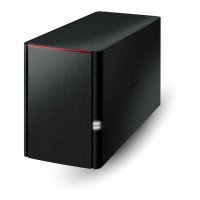
Do you have a question about the Buffalo LS220D0802-EU and is the answer not in the manual?
Visual representation of the LinkStation's components and ports.
Initial setup steps for security and basic file sharing.
Guide to installing the NAS Navigator2 utility.
Steps to install the mobile application for LinkStation management.
Instructions for installing the WebAccess application.
How to access shared folders from computers and mobile devices.
Proper procedures for powering the LinkStation on and off.
How to access LinkStation settings via a web browser.
Accessing simplified configuration options through Easy Admin.
Accessing the comprehensive configuration interface.
Accessing LinkStation settings using a mobile application.
Overview of settings configurable via the mobile app.
Steps to create new shared folders on the LinkStation.
How to create new user accounts for accessing the LinkStation.
Steps to create user groups for managing permissions.
Setting access permissions for shared folders.
Configuring access restrictions for local users and groups.
Integrating LinkStation with an Active Directory environment.
Using NT domain for user authentication and access control.
Linking to an external server for centralized user management.
Overview of RAID modes and their functions.
How to manage RAID settings.
Steps to configure drives in JBOD mode.
Procedures for changing the RAID configuration.
Using RMM to create or expand RAID arrays.
Performing disk checks and repairs on RAID arrays.
Connecting and configuring external USB drives.
Procedures for safely removing USB drives.
Performing disk integrity checks.
Steps to format internal and external drives.
Securely erasing all data and restoring factory defaults.
Setting storage limits for users and groups.
Procedures for replacing a failed hard drive.
Steps to rebuild a RAID array after drive replacement.
Initiating RAID rebuild using the mobile application.
Accessing LinkStation files remotely via the internet.
Setting up and using the FTP server for file access.
Overview of backup destinations.
Setting up automated backup tasks.
Configuring LinkStation as a Time Machine backup destination.
Sharing media files on the local network.
How to play media content on DLNA devices.
Viewing devices connected to the DLNA server.
How to stream media files to DLNA devices.
Blocking specific DLNA devices from accessing media.
Sharing music files with iTunes clients.
Downloading files efficiently using BitTorrent.
Accessing the BitTorrent download manager.
Procedures for downloading files using the manager.
Configuring the LinkStation to send email alerts.
Setting the LinkStation to enter standby mode to save energy.
Using SSL/TLS for secure communication.
Resetting the LinkStation to its original settings.
Updating the LinkStation's firmware.
Configuring system identification and localization settings.
Optimizing network performance with jumbo frames.
Using NAS Navigator2 for Windows to manage the LinkStation.
Using NAS Navigator2 for macOS to manage the LinkStation.
Overview of NovaBACKUP utility for data backup.
Interpreting power LED status codes for errors.
Interpreting amber LED status for system messages.
List of default configurations for the LinkStation.
Technical specifications of the LinkStation.
FCC statements and Proposition 65 warnings for US users.
EU Declaration of Conformity and language-specific warnings.
 General
| Model | LS220D0802-EU |
|---|---|
| Category | Network Storage Server |
| Form Factor | Desktop |
| Total Storage Capacity | 8 TB |
| Installed storage drive type | HDD |
| Number of Bays | 2 |
| Number of storage drives installed | 2 |
| Storage drive capacity | 4 TB |
| RAID Support | Yes |
| Ethernet LAN (RJ-45) ports quantity | 1 |
| USB port | Yes |
| USB 2.0 ports quantity | 1 |
| Weight | 1.5 kg |
| Operating Temperature | 5 - 35 °C |
| Operating Humidity | 20 - 80 % |
| Ethernet LAN data rates | 10/100/1000 Mbit/s |


 To Next Page