Avoid needless heavy braking. Some people drive in
Anti-Lock
Brakes
(ABS)
spurts
--
heavy acceleration followed by heavy
braking
--
rather than keeping pace with traffic. This is a
mistake. Your brakes may not have time
to
cool between
hard stops. Your brakes will wear
out
much faster if
you
Your vehicle has anti-lock brakes (ABS). ABS
is
an
advanced electronic braking
system
that will help
prevent a braking skid.
do
a
lot
of heavy braking.
If
you keep pace with the
traffic and allow realistic following distances,
you
will
eliminate a lot
of
unnecessary braking. That means
better braking and longer brake life.
If
your engine ever stops while you’re driving, brake
normally but don’t pump your brakes.
If
you do, the
pedal may get harder
to
push down.
If
your engine
stops,
you
will still have some power brake assist. But
you will use it when you brake, Once the power assist is
used up, it may take longer to stop and the brake pedal
will
be
harder
to
push.
When you start your engine and begin to drive away,
your anti-lock brake system
will
check itself. You may
hear a momentary motor or clicking
noise
while this
test
is going
on,
and you may even notice that your brake
pedal moves a little. This is normal.
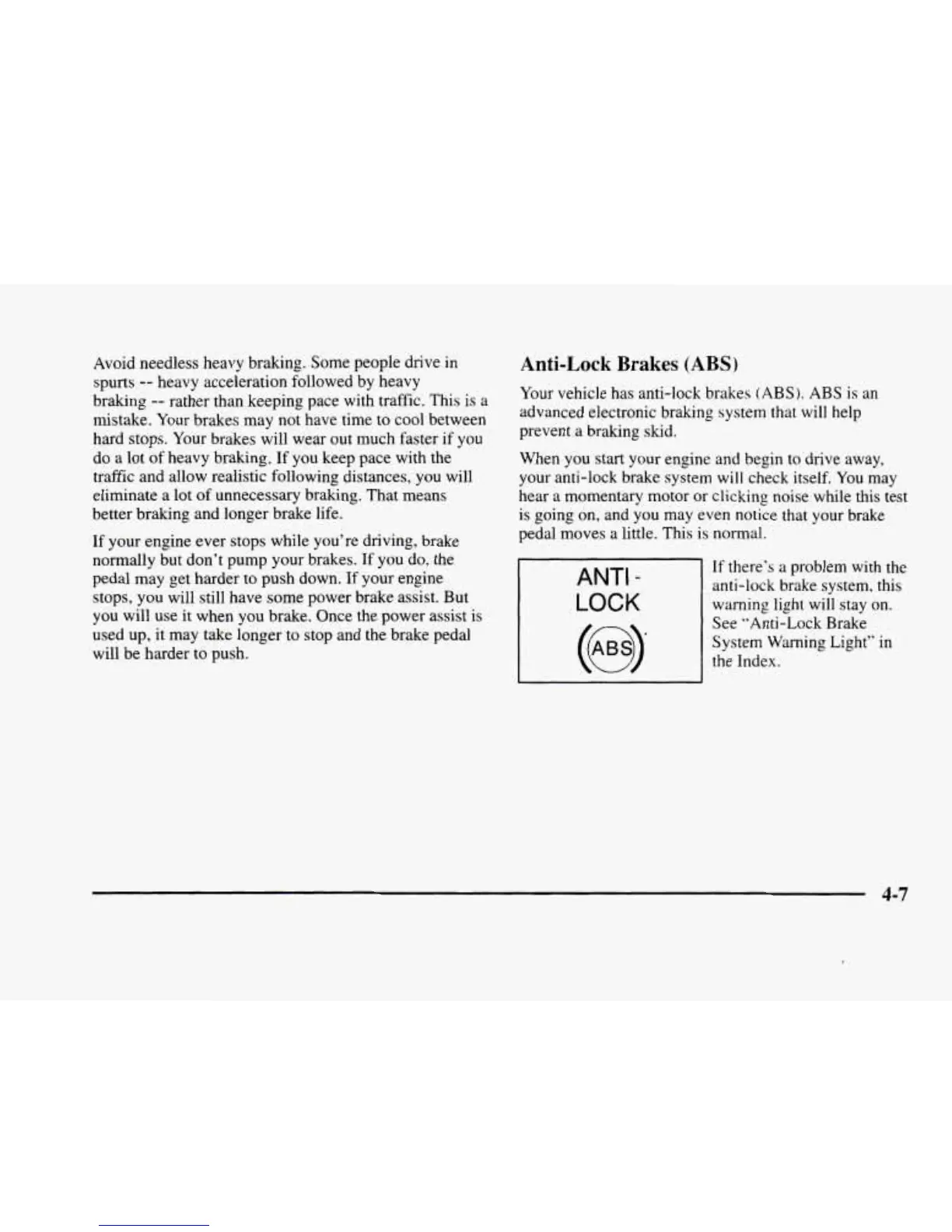
If
there’s
a
problem with the
anti-lock brake system, this
warning light will stay on.
See “Anti-Lock Brake
System Warning Light” in
the Index.
4-7



 To Next Page