Loading
Your
Vehicle
[@
OCCUPANTS
VEHICLE
CAP,
WT.
TIRE-LOADING
INFORMATION
KG
LBS.
FRT. CTR.
RR.
TOTAL
MAX. LOADING
&
GVWR
SAME
AS
VEHICLE
CAPACITY
WEIGHT
XXX
COLD TIRE
TIRE
SIZE
SPEED
PRESSURE
RTG
PSL’KPa
FRT.
RR.
SPA.
IF
TIRES ARE
HOT,
ADD
4PS1!28KPa
SEE
OWNER‘S
MANUAL
FOR
ADDITlONAL
\INFORMATION
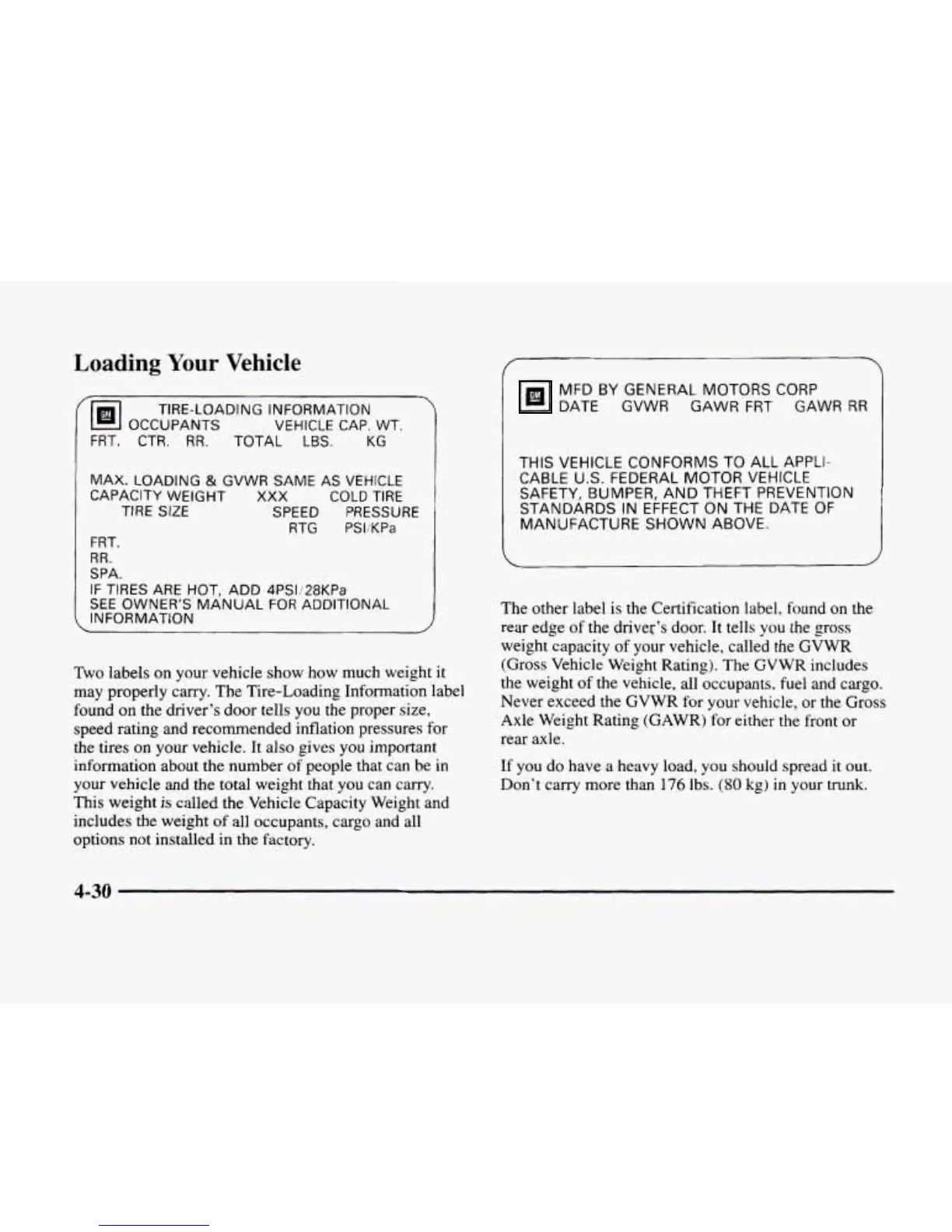
Two labels on your vehicle show how much weight it
may properly carry. The Tire-Loading Information label
found
on
the driver’s door tells you the proper size,
speed rating and recommended inflation pressures for
the
tires
on
your
vehicle. It
also
gives you important
information about
the
number
of
people that can be in
your vehicle and the total weight that
you
can carry.
This weight is called the Vehicle Capacity Weight and
includes the weight
of
all occupants, cargo and all
options not installed in the factory.
MFD
BY
GENERAL
MOTORS
CORP
DATE GVWR
GAWR
FRT GAWR
RR
THIS VEHICLE CONFORMS
TO
ALL
APPLI-
CABLE
US.
FEDERAL MOTOR VEHICLE
SAFETY,
BUMPER,
AND
THEFT
PREVENTION
STANDARDS
IN
EFFECT
ON
THE DATE
OF
MANUFACTURE
SHOWN
ABOVE.
The other label is the Certification label. found on the
rear edge
of
the drives’s door. It tells
you
the gross
weight capacity
of
your vehicle, called
the
GVWR
(Gross
Vehicle Weight Rating).
The
GVWR includes
the weight
of
the vehicle, all occupants,
fuel
and cargo.
Never exceed
the
GVWR
for your vehicle, or
the
Gross
Axle Weight Rating (GAWR)
for
either the front or
rear axle.
If you do have a heavy load, you should spread it out.
Don’t carry more than
176
lbs.
(80
kg)
in
your
trunk.




 To Next Page