Installation
3
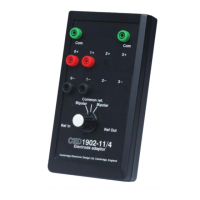
The –B option on the 2- and 4-channel boxes adds an input and
output connector for the 1902 buffer option and also a rotary
switch for selecting common-reference (buffer output drives all
the –ve inputs) or bipolar (buffer not used) modes of operation.
Note that the buffer connectors are inoperative unless the
correct output lead (usually channel 0) is connected to a
CED 1902 fitted with the buffer option. For details of common-
reference operation using a buffer, see page 36.
The 16-channel boxes are available with either 16 signal
electrode inputs plus common reference or 16 electrode pairs
plus 4 buffer connections.
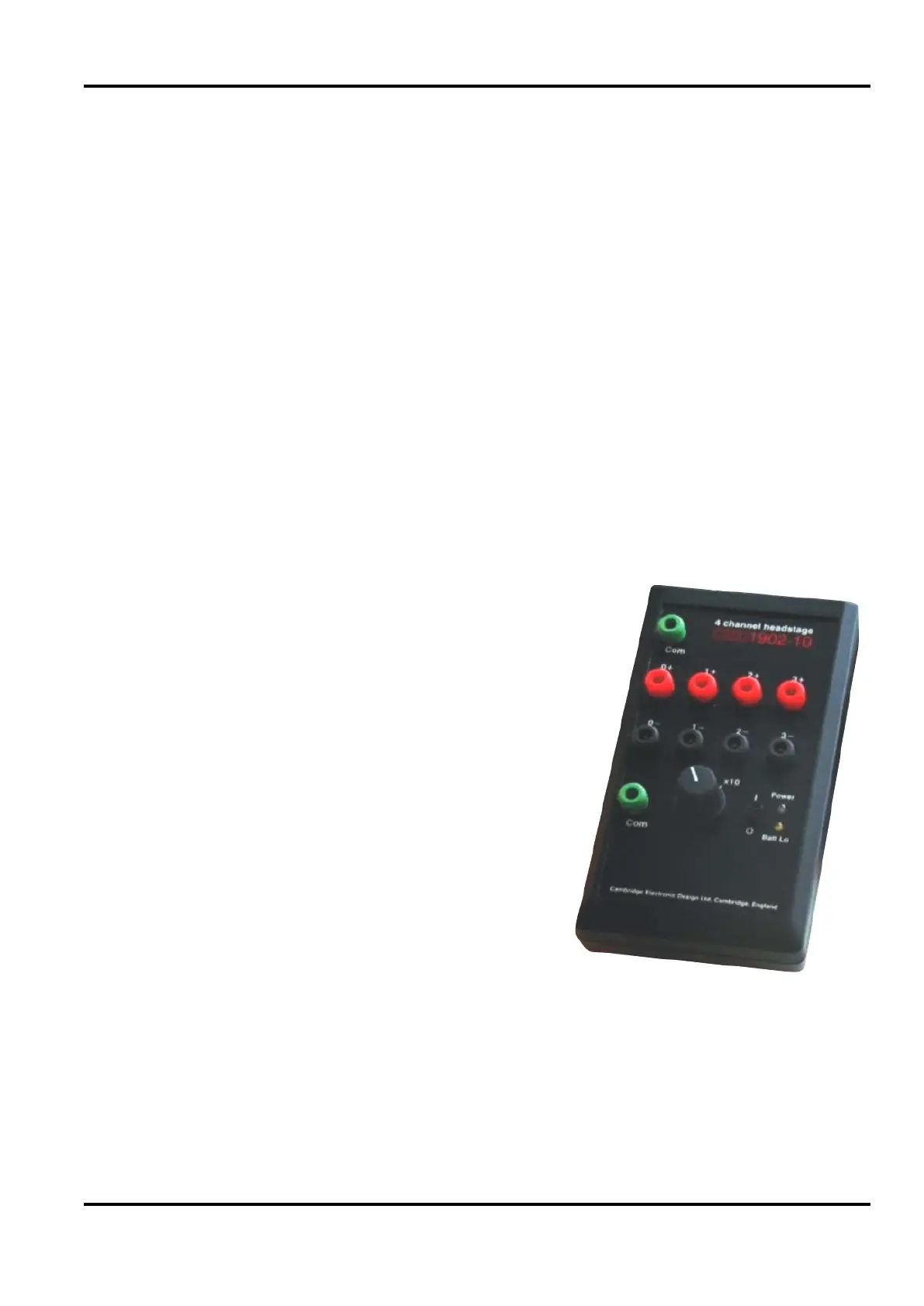
The CED1902-10 Active Head Stage is an optional electrode
adaptor box similar to the CED 1902 11 mentioned above, with
safety-plug connections for up to four electrodes. It contains
either two or four channels
of battery-powered differ-
ential amplifiers with
switchable gains of ×1, ×3,
and ×10. The outputs are
AC coupled, with a corner
frequency of 1.6 Hz. The
Active Head Stage links
together the Common leads
of all electrodes connected
to it. The 1902 clamp
option (see page 41) cannot
be used if this adaptor is
present, because its
amplifiers are upstream of
the clamp circuitry. If
clamping is required, the
CED 2804 External Clamp
Box should be considered
instead.
The 1902 Active Head Stage


 To Next Page