Details of operation
34
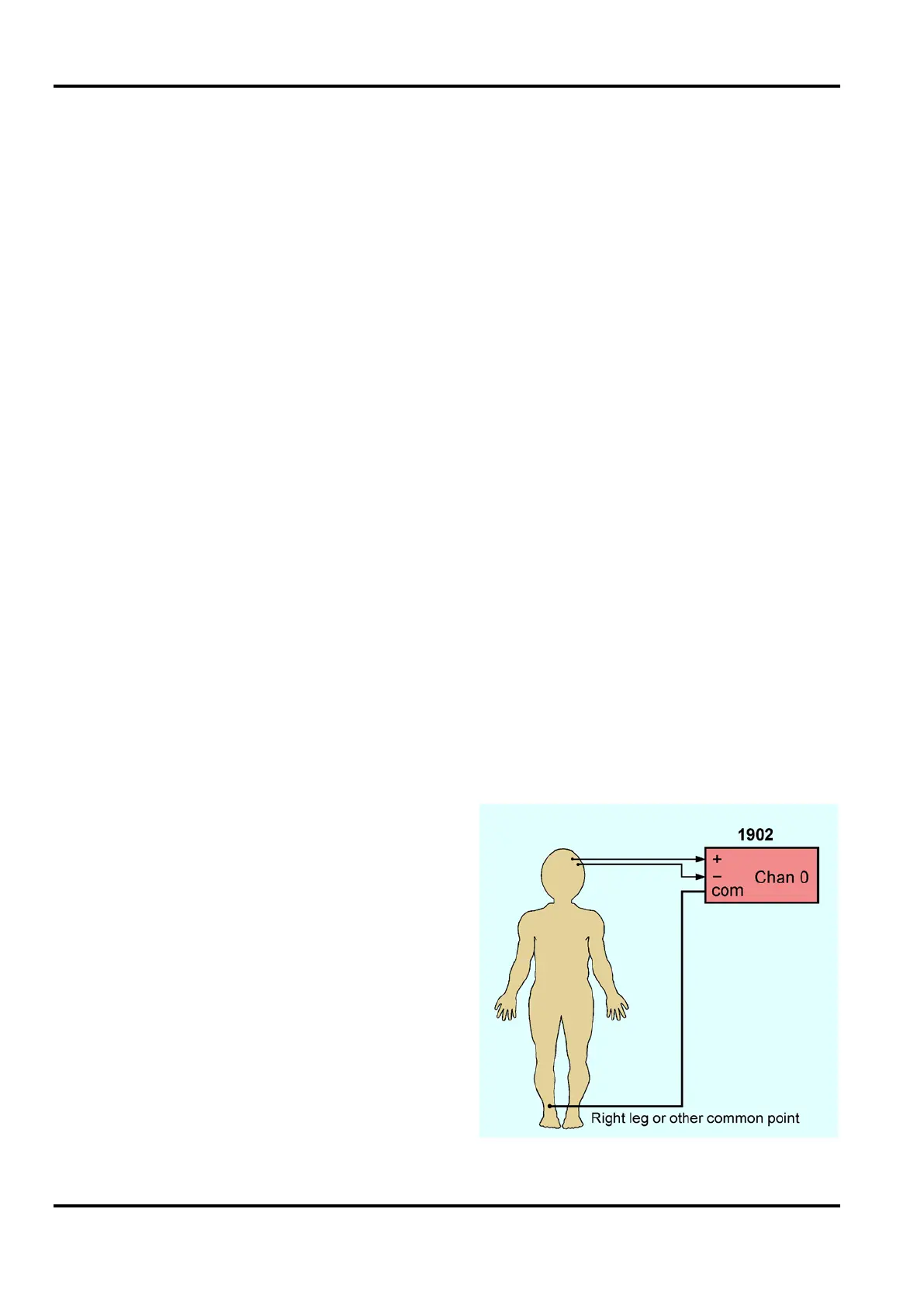
The simplest method of acquiring an electrophysiological signal
with a 1902 is the “Isolated EEG” mode of Spike2, using a
bipolar electrode configuration. This involves three wires: two
as a differential signal input, and a common lead to provide a
return path for the very small input bias currents. NONE OF
THESE LEADS must ever be connected to mains earth. Note
that, for skin-surface recording, the electrodes are always
connected to the isolated input. The transducer input must not
be used with human subjects.
The two signal leads form a differential input. The signal that is
detected and amplified is the algebraic difference between the
voltages on the two electrodes. This is achieved by inverting the
–ve input and summing it with the +ve input. Consequently,
any voltage that is present on both inputs is cancelled out and
not amplified. This is known as common-mode rejection; it
applies to AC as well as DC, so long as there is no phase shift.
It is also limited to a comparatively small input range: about
±1 volt. As an example, if there are +0.500136 volts on the +ve
input and +0.500289 volts on the –ve input:
0.500136 + –0.500289 = –0.000153
The approximately half-volt common-mode signal disappears;
the difference remains and, since the larger signal is on the
inverting input, the result is negative. This is what will be
amplified. Note that in this configuration the electrodes are
symmetrical; neither
signal electrode (nor
the voltage it re-
cords) is privileged
over the other.
All more advanced
modes of operation
are elaborations of
this basic configur-
ation.
Bipolar electrode configuration


 To Next Page