Details of operation
41
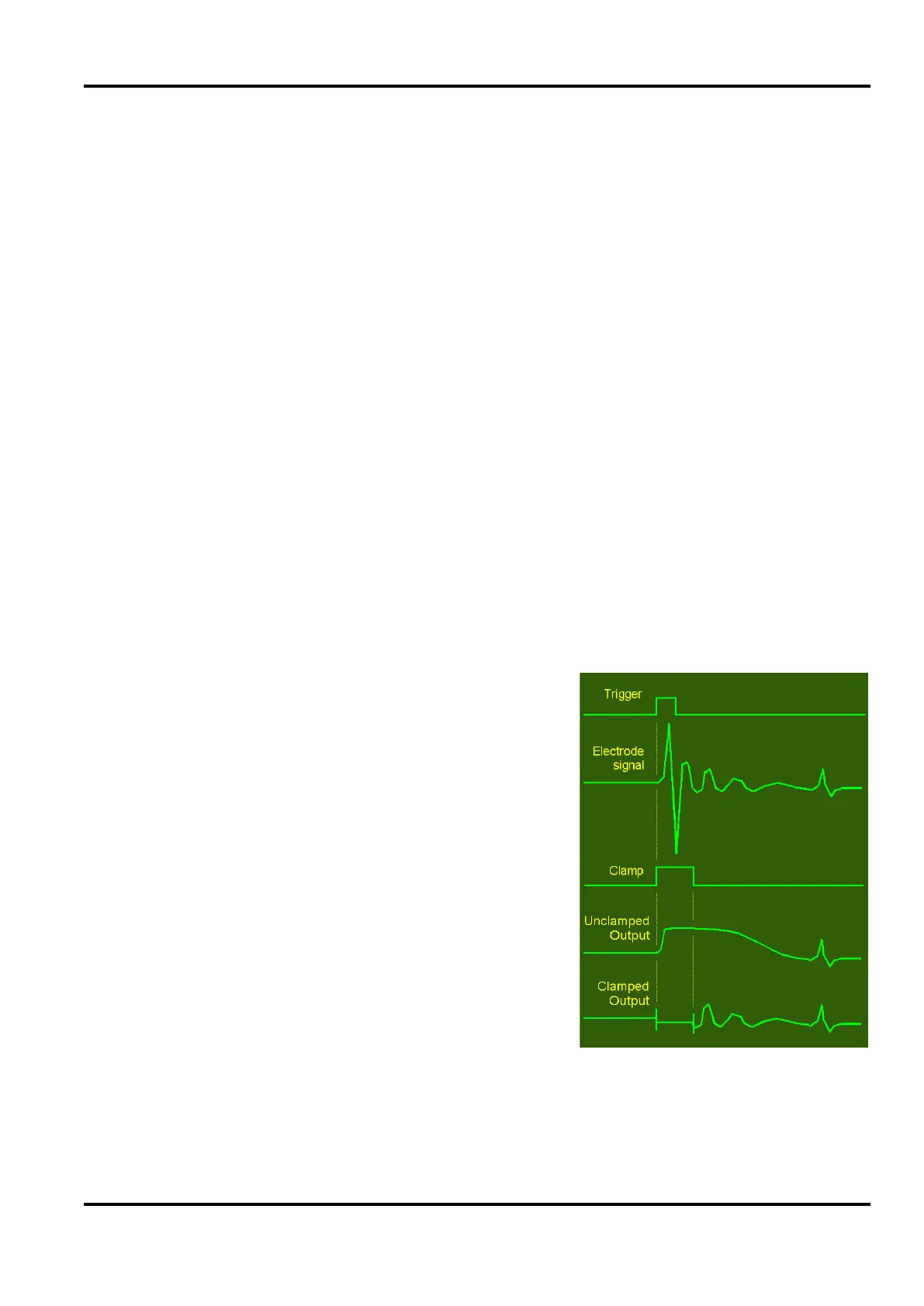
The input clamp option (CED1902-4-C) is designed for use
with triggered stimulation of a subject, where the stimulus
would otherwise overload the isolation amplifier input. Such
overloads may not be electrically damaging, but the amplifier
can take several seconds to recover afterwards, making it
difficult to measure fast responses to the stimulus.
The types of stimulus where clamping can be useful include
fast magnetic field changes and somatosensory stimulus pulses.
In experimental situations where, for example, EMG recordings
are taken from the hand during magnetic stimulation to the
brain, clamping is generally not necessary. However, when very
fast responses (i.e. 2-10 milliseconds after stimulation) are to be
measured, or recordings are taken from the facial area during
stimulation to the head, then input clamping can prevent
amplifier input saturation and allow these recordings to be
made successfully. The clamp will not give good results with
AC coupling, or with the notch filter or high-pass filters
enabled in the 1902.
The clamp input has FET
switches that operate at the
isolated electrode input.
They are opened and closed
by a timing circuit that is
triggered by a pulse at the
Trigger 2 front panel input.
Note that the trigger input is
referenced to system ground
(electrically isolated from
the electrodes), and that the
trigger LED does not need to
be set to
Trigger2 for a
trigger pulse to be routed to
the clamp circuit.
When is the
clamp needed?


 To Next Page