General information
7
In equipment used in research and industry, it is highly
desirable that all functions of instrumentation are readable and
controllable by computer. The 1902 achieves this by one of the
most universal means: the RS232 serial line, or else an RS232
virtual port implemented on a USB adaptor.
When recording electrophysiological signals from live human
subjects, it is a legal and ethical necessity to protect them from
electric shock. This is all the more so since, with electrodes
close to vital organs, a very small current can be fatal.
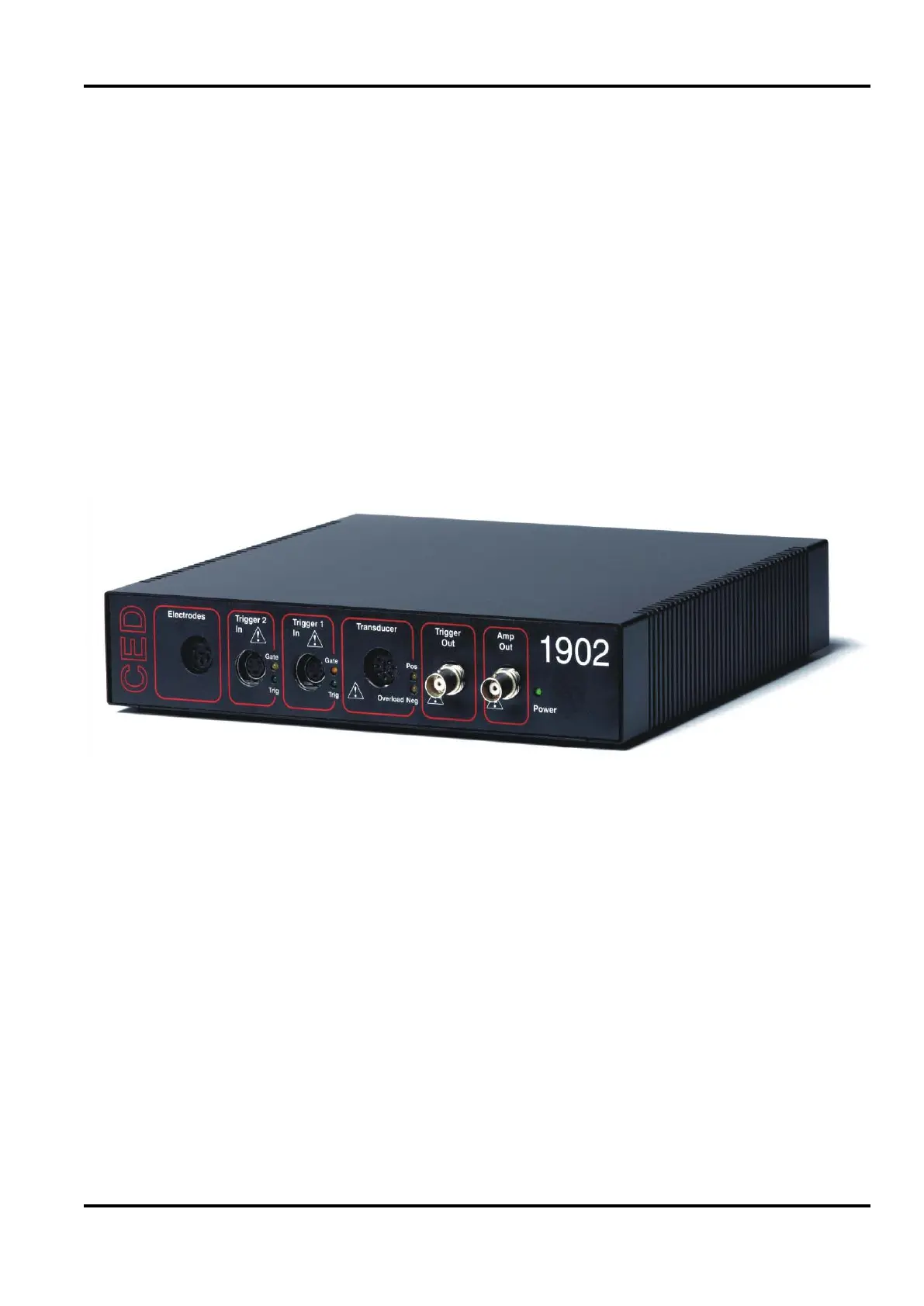
Consequently, the 1902 has provision for an isolation amplifier
that has been approved for use with human subjects.
The 1902 has been type-tested and found to meet the
requirements of the European EN55022:1987 Class B and the
USA FCC Part 15 J Class B radio frequency interference
specifications when used with the specified power supplies and
cables.
The 1902 meets the safety requirements of BS EN5724
(IEC EN60601-1) when used with a CED-approved power
supply, BSI certificate no 221/000018, issued 17 September
1997.
The 1902’s isolation approvals may not be relevant to industrial
users. The unit will run on other power supplies (see page 32)
but it is important to note that the 1902 does not meet
EN 60601-1-1:2000 safety and EN 60601-1-2:2001 EMC
standards unless used with the CED-approved power supplies.


 To Next Page